Newly Established Wildlife Management Area Named in Honor of Late AGFC Director
ON 09-10-2026
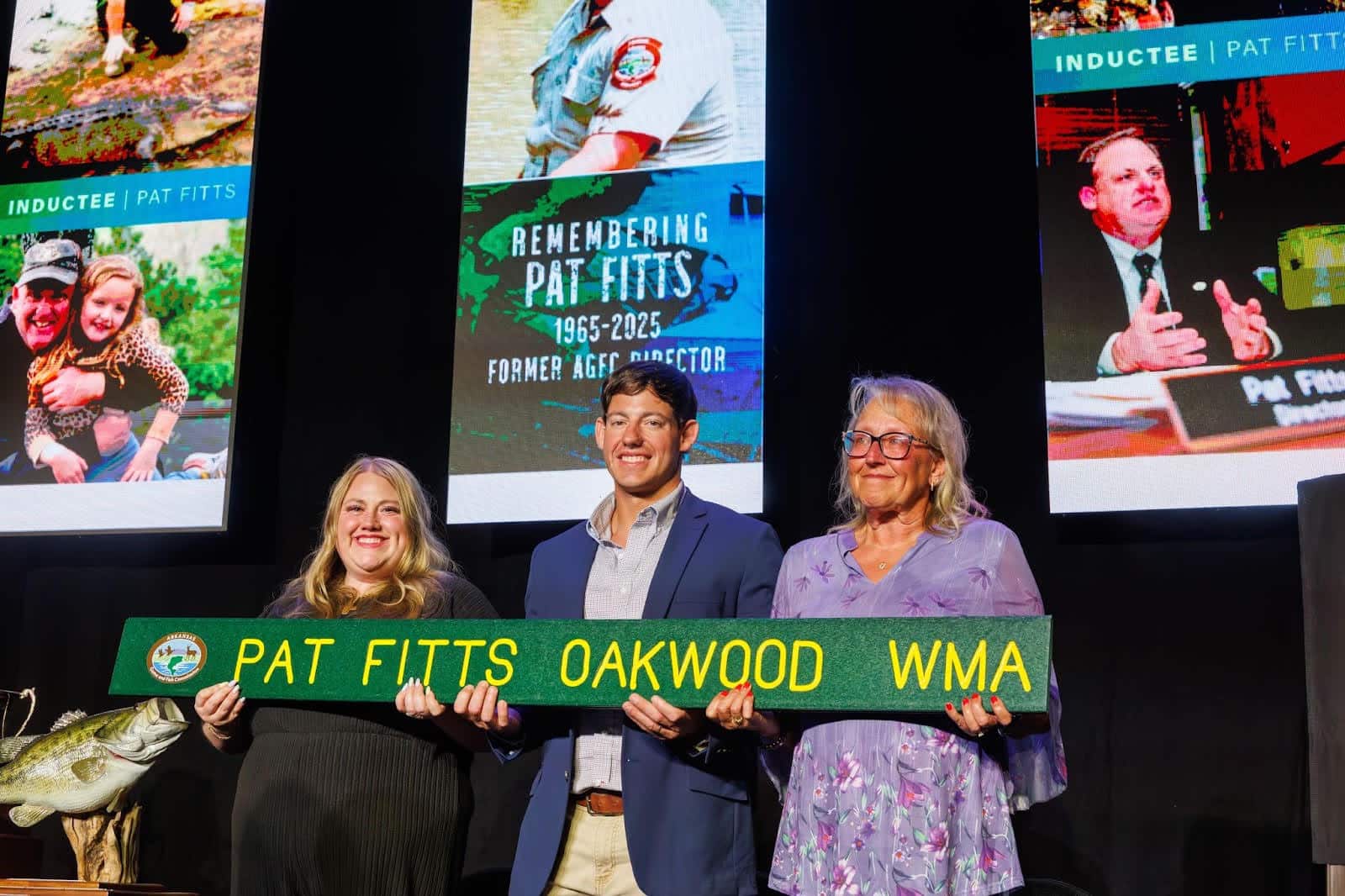
WYNNE — The Arkansas Game and Fish Commission unanimously approved the official name of the state’s latest wildlife management area as Pat Fitts Oakwood WMA at its monthly meeting held Wednesday at the Bill Thomas Wynne Economic Development Commission Building and Technology Center in Cross County.
Pat Fitts Oakwood WMA was added to the AGFC’s hunting opportunities earlier this year, thanks to a land trade between the agency and the U.S. Fish and Wildlife Service. The USFWS previously owned the land known as the Oakwood Unit, but without a public right-of-way to the property, public hunting wasn’t allowed. Fitts worked diligently during his time as AGFC director to work out the details in opening this 2,206-acre area to the public.
Fitts’ steadfast commitment to conservation and the people of Arkansas was evident throughout his 32-year career with the agency. He was a calming influence throughout one of the agency’s and the country’s most trying times — the COVID-19 pandemic. In the face of a world shutting down, Fitts led the AGFC to the completion of the J.B. and Johnelle Hunt Family Nature Center in Springdale and led the charge to begin renovation of the Joe Hogan State Fish Hatchery in Lonoke, the AGFC’s oldest and largest fish hatchery. Oakwood was one of the last initiatives Fitts worked on before his retirement in 2021.
“It has taken five years to complete the work Fitts started, but thanks to his vision and work, Arkansans have a new WMA in an area of the state where public access is getting harder to implement at this scale,” AGFC Deputy Director Brad Carner said. [LINK TO PRESENTATION]
The Commission also approved a budget increase of $5.1 million for the agency’s Private Lands Habitat Division to fund habitat improvements and public hunting opportunities on private land. The money for this increase comes from a combination of governor’s set-aside restricted reserve funds and a recently awarded Voluntary Public Access Grant from the Natural Resources Conservation Service.
“Five million dollars of this increase comes from Gov. Sarah Sanders’ set-aside that was approved by the General Assembly to fund our Conservation Incentive Program,” Garrick Dugger, chief of the AGFC’s Private Lands Habitat Division, said. “In addition to funding eight different habitat management practices for qualifying landowners, we’re going to use $3 million of this set-aside as a cash match for another proposed grant that, if awarded, could bring an additional $10 million to be used to fund CIP in the future. I can’t thank Gov. Sanders and the state Legislature enough for their confidence in us to support wildlife habitat conservation on private lands in Arkansas.”
The remaining $100,000 of the budget increase will complete the implementation of this year’s Waterfowl Rice Incentive Conservation Enhancement Program. The WRICE program not only offers financial incentives for rice producers to forgo fall tilling of their fields and flood that acreage for waterfowl habitat, but also opens these enrolled rice fields to limited public access through draw hunts conducted during duck season.
“The money for this program comes from the recent $2.1 million Voluntary Public Access Grant awarded to the AGFC to be used in the next three years,” Dugger said. “Thanks to this grant, we’ll be able to continue this program that helps keep flooded rice on the landscape at a time when flooded winter acreage is facing a sharp downturn. We’ve lost nearly a third of last year’s rice acreage to other crops this year due to economic drivers making it very difficult for rice farmers to make a profit on their crops. This, plus the ongoing drought, makes every flooded acre of open fields critical to winter waterfowl habitat.” [LINK TO PRESENTATION]
The Commission devoted much of the remainder of Wednesday’s meeting to presentations on wind and solar energy development in Arkansas and how it may shift future wetland habitat use by both waterfowl and waterfowl hunters. Advancements in wind energy technology have made wind turbines more effective in Arkansas, leading to increased interest in their use. Commissioners Brandon Adams and Philip Tappan both stressed that the agency is not a regulatory authority over wind and solar energy, but has recently been included in the Arkansas Wind Energy Development Act 945 as one of the agencies to which proposed facilities must report their plans before construction. The AGFC’s role in these plans is to review proposals and educate prospective facility owners about possible effects this infrastructure may have on wildlife and wildlife habitat in The Natural State.
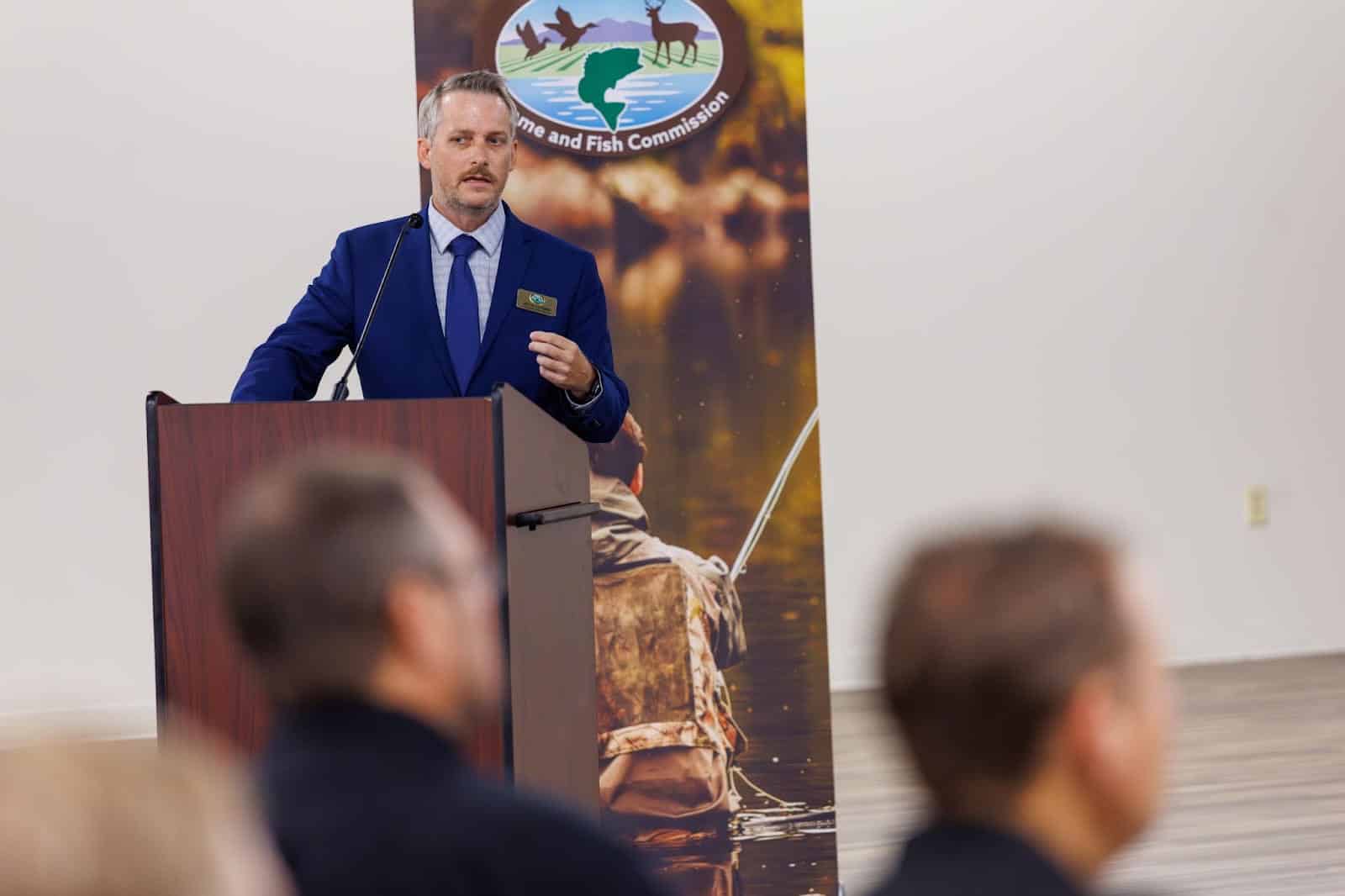
The topic began with an in-depth presentation by Justin Stroman and Ellery Lassiter, who work in the agency’s Conservation Support Division, on the AGFC’s involvement in reviewing wind energy projects and how these facilities may affect wildlife populations, including endangered species, bats and migratory birds. Stroman led the presentation with a primer on the agency’s increased role in advising companies planning to construct facilities in the state. Lassiter followed with a brief overview of the many research projects the AGFC is coordinating specifically on waterfowl density and possible habitat-use shifts after the installation of these energy facilities. [LINK TO PRESENTATION]
J.D. Wilson, vice chair of biological sciences at the University of Arkansas, spoke about the possible effects of solar energy facilities on wildlife. According to Wilson, the rate of solar expansion and size of solar facilities have increased massively throughout the Southeast in the last two decades, outpacing research on possible impacts on wildlife such as pollinators, which are critical to Arkansas agriculture. Many solar farms require large, undisturbed grasslands underneath the panels, which could, with the proper planning, become beneficial to grassland species, which make up a large portion of Arkansas’s species of greatest conservation need. [LINK TO PRESENTATION]
Joe Lancaster from Ducks Unlimited wrapped up the wind energy discussion with a presentation on the recent research coordinated by DU in Louisiana, Mississippi and Arkansas concerning waterfowl species diversity and densities in the Lower Mississippi Alluvial Valley and its correlation with various environmental conditions and land-use patterns. Maps and geospatial information resulting from this research promise to be valuable to municipalities in decision-making on the placement of proposed projects. [LINK TO PRESENTATION]
Wednesday’s meeting included a presentation on the fingerling bass produced through AGFC’s Legacy Lunker program at the newly renovated Joe Hogan State Fish Hatchery in Lonoke. This year, hatchery staff produced an estimated 300,000 “lunkerlings” from 19 fish turned in by public water anglers that qualified for the program’s 10-pound minimum weight.
“Some of the fish didn’t spawn, which is pretty common for Texas’ (ShareLunker) operation, but some spawned multiple times,” Stockman said, noting Texas’ trophy bass program that Arkansas’s Legacy Lunker mirrors. “Lunker 13 actually spawned five times. Being our first year, we’re very pleased with the amount of production we received. Texas’s ShareLunker program has been in place for 40 years, and they produced an estimated 350,000 fingerlings from their program this year, so we’re doing extremely well for our first year in this program.” [LINK TO PRESENTATION]
Commissioners also heard from AGFC Arkansas Outdoor Education Manager Derek Ratchford and members of the Wynne Junior High staff and students about their experiences in building outdoor educational programming essential in the school’s recent recognition as one of the AGFC’s Schools of Conservation Leadership. [LINK TO PRESENTATION]
In other business, the Commission:
-
Approved the removal of a stolen laptop computer with an original value in 2022 of $1,117.75 and a current net book value of $0 from agency inventory.
-
Approved a 2-acre utility easement with Rice Belt Telephone Company for the installation of a new fiber-optic communication line on a previously existing easement with Entergy Arkansas at Bayou DeView WMA.
-
Authorized Director Doug Schoenrock to complete the necessary documentation to create a permanent easement adjacent to the McCallie Access Boat Ramp in Desha County to provide access to adjacent private land.
A video of the meeting is available on the AGFC’s YouTube Channel.
####
CUTLINES:
SIGN
The family of former AGFC Director Pat Fitts was honored with the announcement of the naming of Pat Fitts Oakwood WMA at the Arkansas Game and Fish Foundation Banquet in August. AGFC photo by Mike Wintroath.
SPEAKER IN BLUE
AGFC Environmental Coordination Biologist Justin Stroman spoke about recent developments in wind and solar energy policy in Arkansas. AGFC photo by Mike Wintroath.
SPEAKER IN NAVY
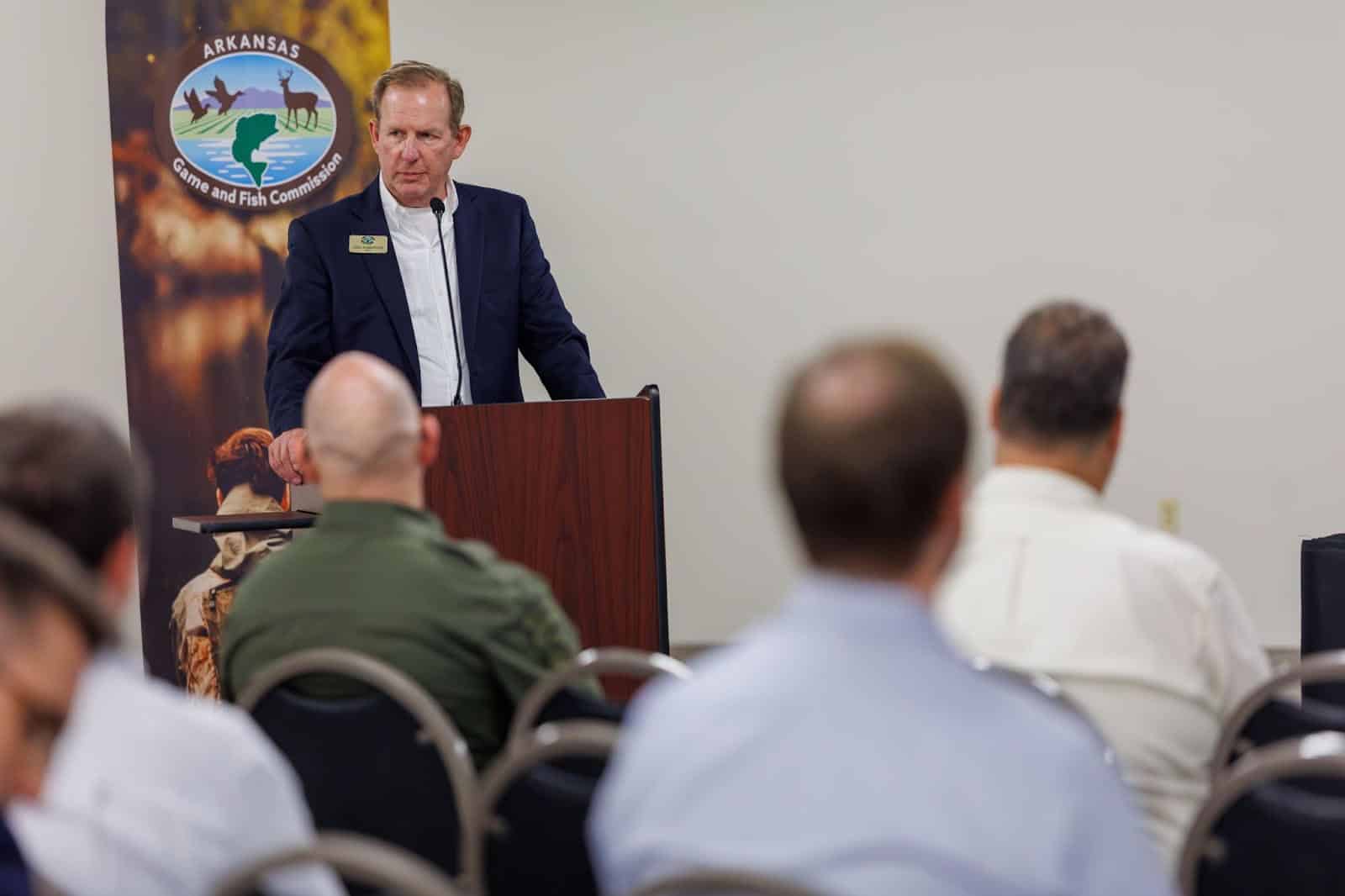
AGFC Director addressed a full room in Wynne, Arkansas, to update everyone on the latest successes from the AGFC. AGFC photo by Mike Wintroath.
BOAT RAMP
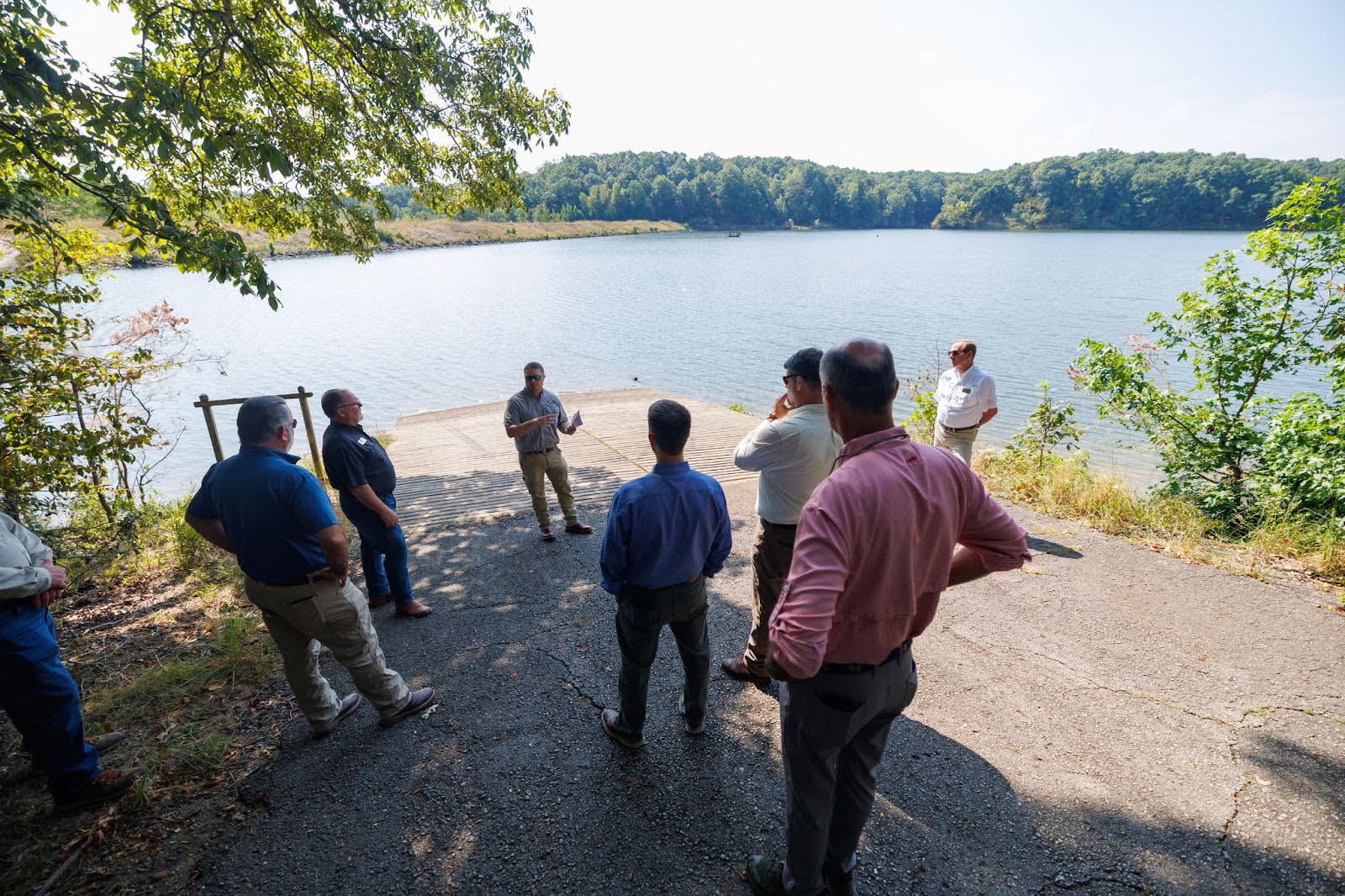
Commissioners toured Lake Austell at Village Creek State Park, which produced three of the 10-pound-plus largemouth bass used in this year’s Legacy Lunker trophy bass spawning program. AGFC photo by Mike Wintroath.
Recent News
AGFC Jonesboro Field Office Rebuild On Track
Sep. 9, 2026
AGFC Commissioner Meeting Announcement
Sep. 8, 2026
Subscribe to Our Weekly Newsletter E-mails
Don’t miss another issue. Sign up now to receive the AGFC Wildlife Weekly Newsletter in your mailbox every Wednesday afternoon (Waterfowl Reports are published weekly during waterfowl season and periodically outside the season). Fishing Reports arrive on Thursdays. Fill in the following fields and hit submit. Thanks, and welcome!