
Deer-specific Hunting Regulations
Tagging and Checking a Deer
Option 1:
Immediately upon harvest and before moving your deer, you can check your game via the internet, through the AGFC mobile app or by phone at 833-289-2469.
Click here to download the new AGFC app for your Android device.
Click here to download the new AGFC app for your Apple device.
If you are using the AGFC mobile app to check game and are not connected to internet or cell service, you’ll receive a notice on your screen that your submission is pending upon validation. When your device returns to service or internet connection, you should sync your app by selecting the sync button. Once the submission goes through, you will receive your confirmation on the app screen, via email and in your app inbox.
Option 2:
- Immediately upon taking a deer (before moving it), fill out the appropriate deer tag from your license and complete all information, except Check #, legibly and in ink (you may substitute a piece of paper for this tag). Fasten the tag to the ear or antler. The original tag must remain as attached to the deer until point of final storage.
- Duplicate harvest information reflecting the name, address, species, sex, date taken and check confirmation number must remain with all portions until point of final storage, including while in transit. Click here to access a Carcass ID Tag.
- For deer harvested on private lands, use the current deer zone map for zone numbers.
- For deer harvested on public lands, use the zone number listed on the appropriate area in the current Hunting Guidebook.
- Call 833-289-2469, visit www.agfc.com/license or use the AGFC mobile app to check your deer within 12 hours of harvest.
- After checking game, record the check number on your tag.
- Entrails may be removed, but evidence of the animal’s sex must remain until checked. Deer may be quartered in the field, but the head must be kept within arm’s reach of all four quarters of the animal until checked.
- No deer/elk may be transported out of the CWD Management Zone without following these procedures.
- No big-game animal may be transported across state lines before being checked unless normal travel routes require a hunter to cross a state line to check the animal.
- If you choose to give away all or a portion of your game after it has been checked, you must use a game transfer form.
- Resident youth will need product code YGT (Resident Youth Game Tag) to check a deer or turkey. Nonresident youth will need product code YDTN to check a deer and YTTN to check a turkey.
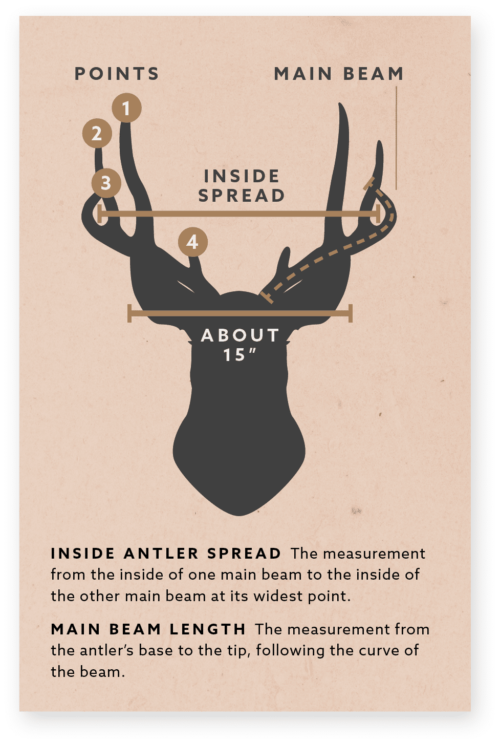
What Is A Legal Buck?
For Youth Hunters:
Hunters who are 6 to 15 years old may harvest any buck without regard to antler size or points.
For All Other Hunters:
On private land within the CWD Management Zone:
- Any buck may be harvested, regardless of antler size or points.
On private land within Deer Zones 16, 16A (excluding Ashley County) and 17 (excluding Mississippi County), a legal buck must have:
- Both antlers under 2 inches (button buck),
- An inside spread of at least 15 inches, or
- At least one main beam 18 inches or longer
On all other private land, a legal buck must have:
- Both antlers shorter than 2 inches (button buck) or
- Have at least three points (including the main beam) on one side of his rack. Points must be at least 1 inch long to count.
Button Bucks
Any buck with antlers shorter than 2 inches should be checked as a button buck regardless of the county or deer zone where it was harvested.
- Statewide, all button bucks must be checked as a button buck.
- Button bucks count toward a hunter’s antlerless bag limit.
Legal Hunting Equipment
Long, recurve and compound bows: Must have at least a 35-pound pull. Scopes, string locks and mechanical string releases may be used. Big-game hunters must use arrowheads at least 7/8-inches wide (including mechanicals). Arrows and arrowheads containing firearm ammunition or poison may not be used.
Crossbow: Crossbows must have at least a 125-pound pull and a mechanical safety. Scopes may be used. Big-game hunters must use arrowheads at least 7/8-inches wide (including mechanicals). Arrows and arrowheads containing firearm ammunition or poison may not be used.
Propelled Arrows: Arrows propelled from a compressed air system or by the action of an explosive or combustible propellant may not be used.
Spear: Spears may be used during archery seasons.
The following firearms are allowed during the alternative firearms season:
- Muzzleloading rifles with a barrel 18 inches or longer and of .40 caliber or larger.
- Magnifying sights may be used.
- Buckshot size 4 or larger may be used to hunt deer with a muzzleloader.
- Muzzleloading handguns with barrels 9 inches or longer and:
- .45 caliber or larger if they shoot conical bullets (200 grains or heavier), or
- .530 caliber or larger if they shoot round balls.
- Non-semiautomatic centerfire firearms (including non-semiautomatic handguns with barrels 4 inches or longer) that fire a straight-wall cartridge .30 caliber or larger.
- Large bore air rifles at least .40 caliber that shoot a single, expandable slug, produce at least 400 feet/pound of energy at the muzzle, and are charged from an external tank. NOTE: Large bore air rifles are not legal for harvesting bear or elk.
NOTE: Shotguns with slugs are not allowed during alternative firearms season.
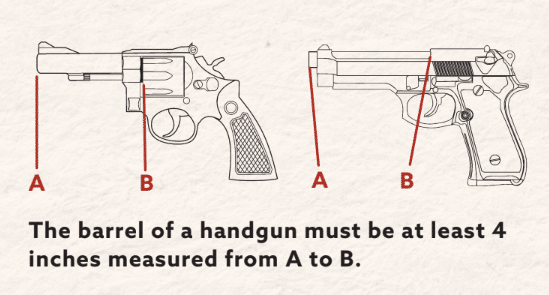
Modern guns and large bore air rifles (see above) may be used for deer EXCEPT:
- buckshot in a .410 shotgun.
- shot smaller than No. 4 buckshot in any shotgun.
- rimfire cartridges.
- centerfire rifles or handguns smaller than .22 caliber.
- handguns with barrels shorter than 4 inches.
NOTE: Handguns smaller than .45 caliber and with barrels no longer than 6 inches may be used to dispatch game wounded with any legal weapon.
- Modern guns, alternative firearms or archery equipment may be used during modern gun deer and bear seasons.
- Hunters may use only alternative firearms or archery equipment during alternative firearms deer or bear seasons.
- Hunters may use only archery equipment during archery deer and bear seasons.
- Hunters may use air rifles on small game.
- Only shotguns (10 gauge and smaller) and archery equipment (including crossbows) are legal for turkey hunting. Shot larger than No. 2 common shot is prohibited.
- Unless otherwise posted, handguns not meeting legal hunting equipment definitions above may be carried on Commission-owned or controlled property.
Hunters and those accompanying hunters in areas where modern gun or alternative firearms deer, bear or elk seasons are open must wear at least 400 square inches of hunter orange, chartreuse or blaze camouflage above the waist and a head garment of those same safety colors. Safety colors are not required for migratory bird hunters in these areas. Click here for hunter orange requirements on ground blinds on WMAs.
Feeding and Baiting Wildlife
Baiting is defined as the direct or indirect placing, exposing, depositing, distributing or scattering of salt, grain or other feed that could serve to lure or attract wildlife to, on or over an area where hunters are attempting to take them. It is legal to feed wildlife, with these exceptions:
- Deer and elk may be hunted over bait in the CWD Management Zone from Sept. 1-Dec. 31 during an open season on private land only.