Arkansas biologists help band this year’s duck migration
ON 12-08-2025
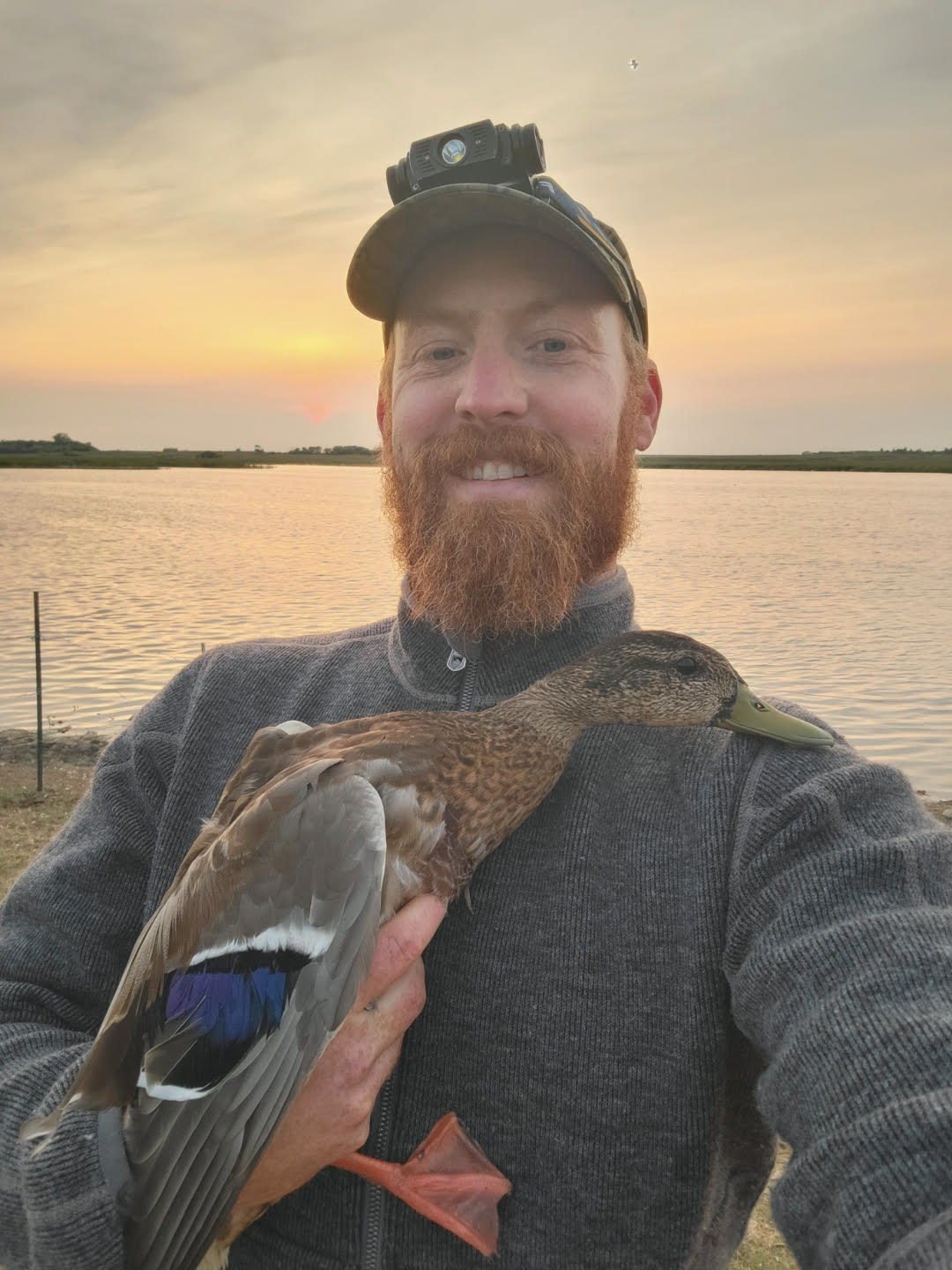
GEORGETOWN — Cayce Guy is waiting with anticipation for the peak of the waterfowl migration at Steve N. Wilson Raft Creek Bottoms Wildlife Management Area — maybe a little more intently this year than any other.
In addition to being an avid waterfowler, Guy is the Arkansas Game and Fish Commission’s wildlife biologist at the WMA. He’s also one of two AGFC biologists who spent a month in the Prairie Pothole Region of the United States, banding thousands of ducks before they began their annual migration to wintering grounds in Arkansas and beyond.
Marking birds and using them to carry messages has been around since before the Dark Ages, but the modern use of metal bands wrapped around the legs of birds to track migration first became popular in the 1800s when John James Audubon claimed to have tied silver thread to young eastern phoebes he captured on his Pennsylvania farm and verified that they returned to their nest sites a year later. During the last century, the United States Geological Survey’s Bird Banding Laboratory has kept tabs on millions of birds to help scientists determine things such as migration routes, distribution, harvest rates and survival rates of migratory birds. Some birds are recaptured by biologists thousands of miles from their banding site and released. With ducks, bands are most often recovered when a hunter harvests the bird. But how do the bands get on the ducks?
Brett Leach, AGFC Waterfowl Program coordinator, says the banding sites often are decided by the species and research needed, and many banding sites for wood ducks, Canada geese and other Arkansas species have been in place for years in The Natural State.
“Those banding efforts give us valuable data on where the birds go from here and used for population estimates and to monitor harvest and survival rates,” Leach said. “But the biggest banding efforts for waterfowl occur in August and September north of here where birds go to nest or molt, and it takes a combined effort from state and federal partners to keep it going.”
According to Leach, the Mississippi Flyway Council Cooperative Bird Banding Program involves all of the states in the Mississippi Flyway, with each state taking turns to band birds in parts of North Dakota and South Dakota. This effort is focused on banding mallards and pintails to inform harvest regulations.
“Until COVID, the Mississippi Flyway preseason banding crew was in Prairie Canada, but travel restrictions had us change our plans,” Leach said. “As it turns out, we actually do just as well, if not better, at banding on the U.S. side of the border because we can use rocket nets here, but traveling across the border with them was highly regulated.”
Guy and Levi Rengstorf, wildlife biologist over Lee Creek WMA in northwest Arkansas, participated in banding crews this year under crew leads from Missouri who were there last year. Next year, Guy and Rengstorf will go back and lead biologists from other states and teach the next crew how to do it. “We’ll send a couple of additional crew members next year to help with the work, too,” Leach said. “Then Arkansas will wait for our turn in the rotation to come back around.”
Regnstorf spent three weeks of September in South Dakota, while Guy spent 3 weeks in North Dakota during the second half of the banding season.
“There was really only one person working full time at the refuge in North Dakota, but he was able to prepare the capture sites before the banding teams arrived,” Guy said. “They mowed the tall grass from the edge of the water on multiple sites and started baiting the birds with barley to come in.”
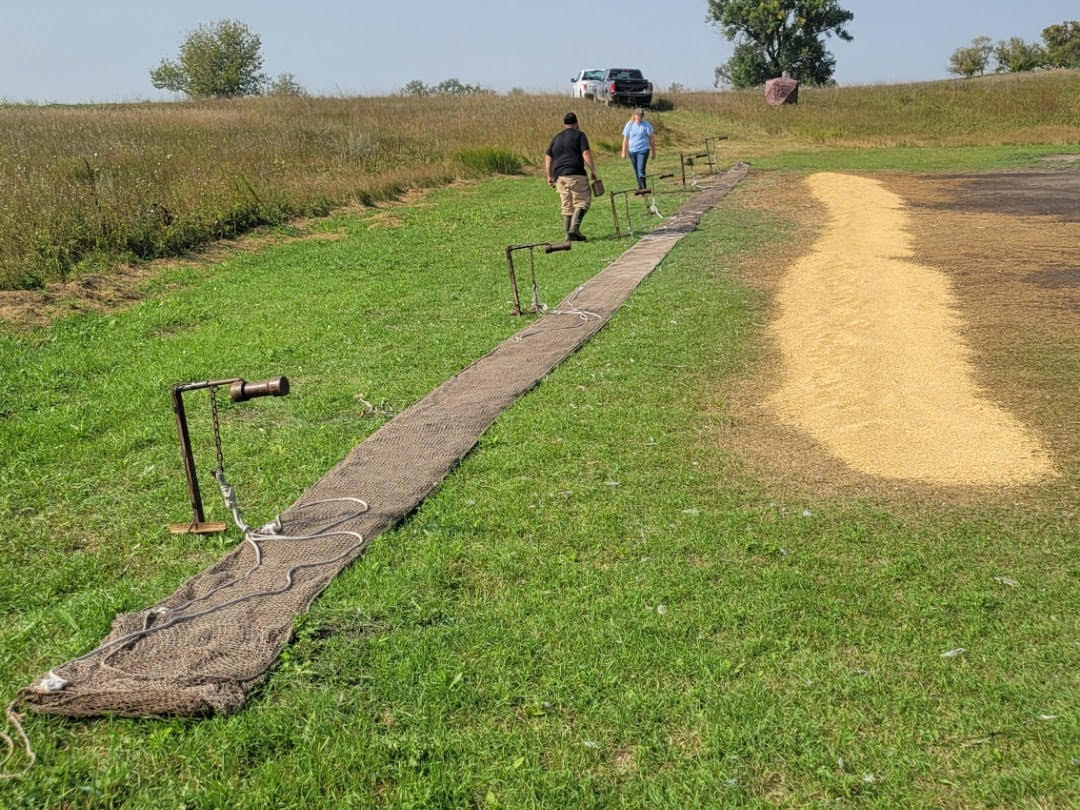
Once the banding teams arrived, they moved the bait further away from the water and set up lines of rocket nets to prepare for a shot.
“Rocket nets look like large fishing nets that are folded behind the bait pile to deploy over the birds,” Guy said. “One end is anchored there and the other end is attached to heavy pipes that are capped on one end and filled with black-powder charges.”
Those “rockets” are connected to a detonator controlled by a biologist hiding nearby. Once the birds are close enough to the nets, the biologist fires the charges, and rockets carry the net over the birds to contain them while the biologists race out to ensure the birds don’t escape, then begin the banding process.
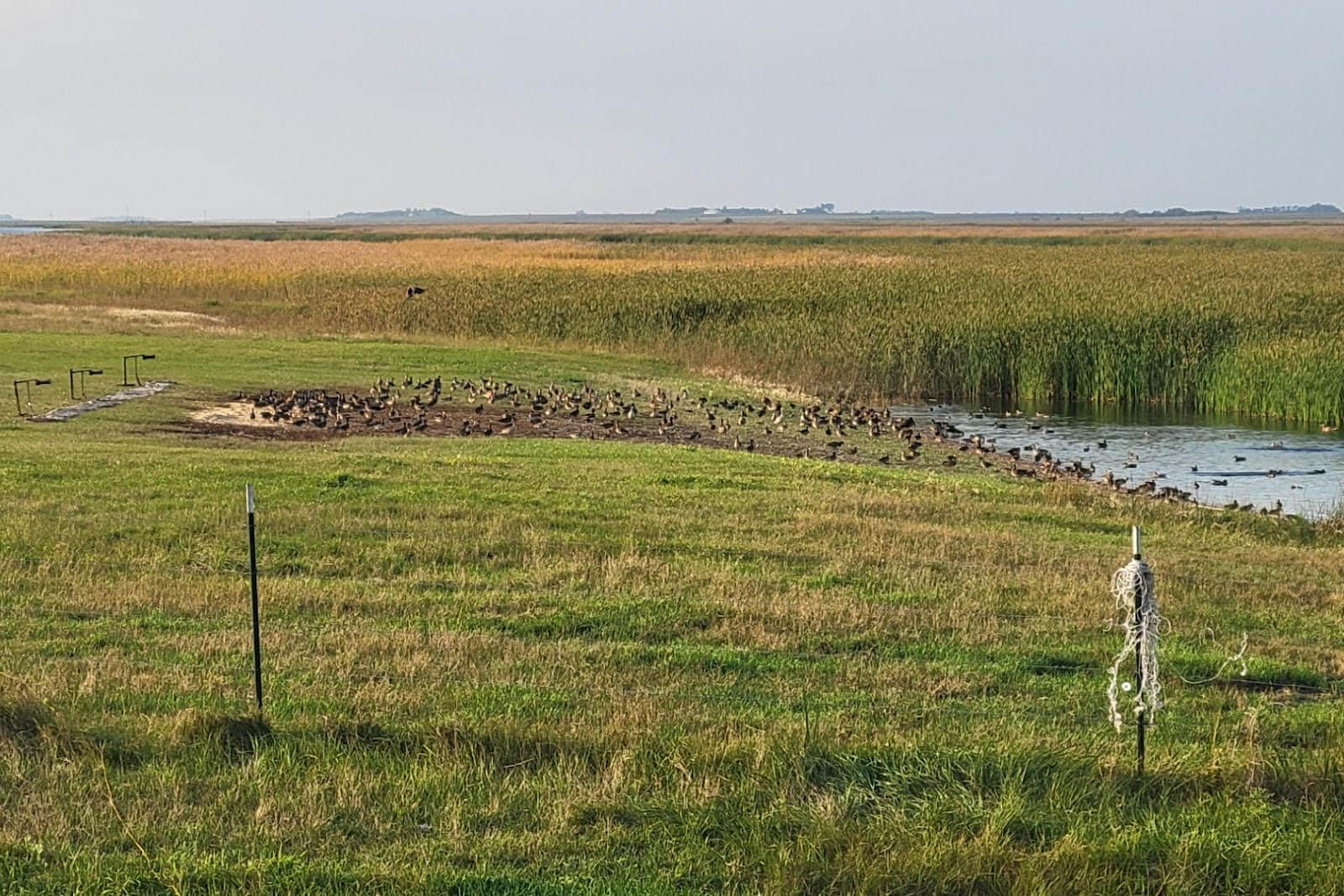
“We’re catching hundreds of birds in a shot, so we have to have them on dry ground to prevent any from drowning in the nets before we can reach them,” Guy said. “The record is more than 1,000 birds caught in a double-net set in one shot a few years ago, but all of the shots taken when I was there caught between 100 and 200 birds.”
Even on land, banding teams have to move quickly. The birds are pulled from the nets, placed into crates, then identified by species, sex and age, all of which are done visually.
“It can be difficult this early in the year for some species because the male ducks’ breeding plumage is not showing the typical vibrant colors yet, making males and females appear very similar,” Guy said. “And the age we record is whether it’s a duck that hatched that spring or is an adult, labeled ‘after hatch year.’
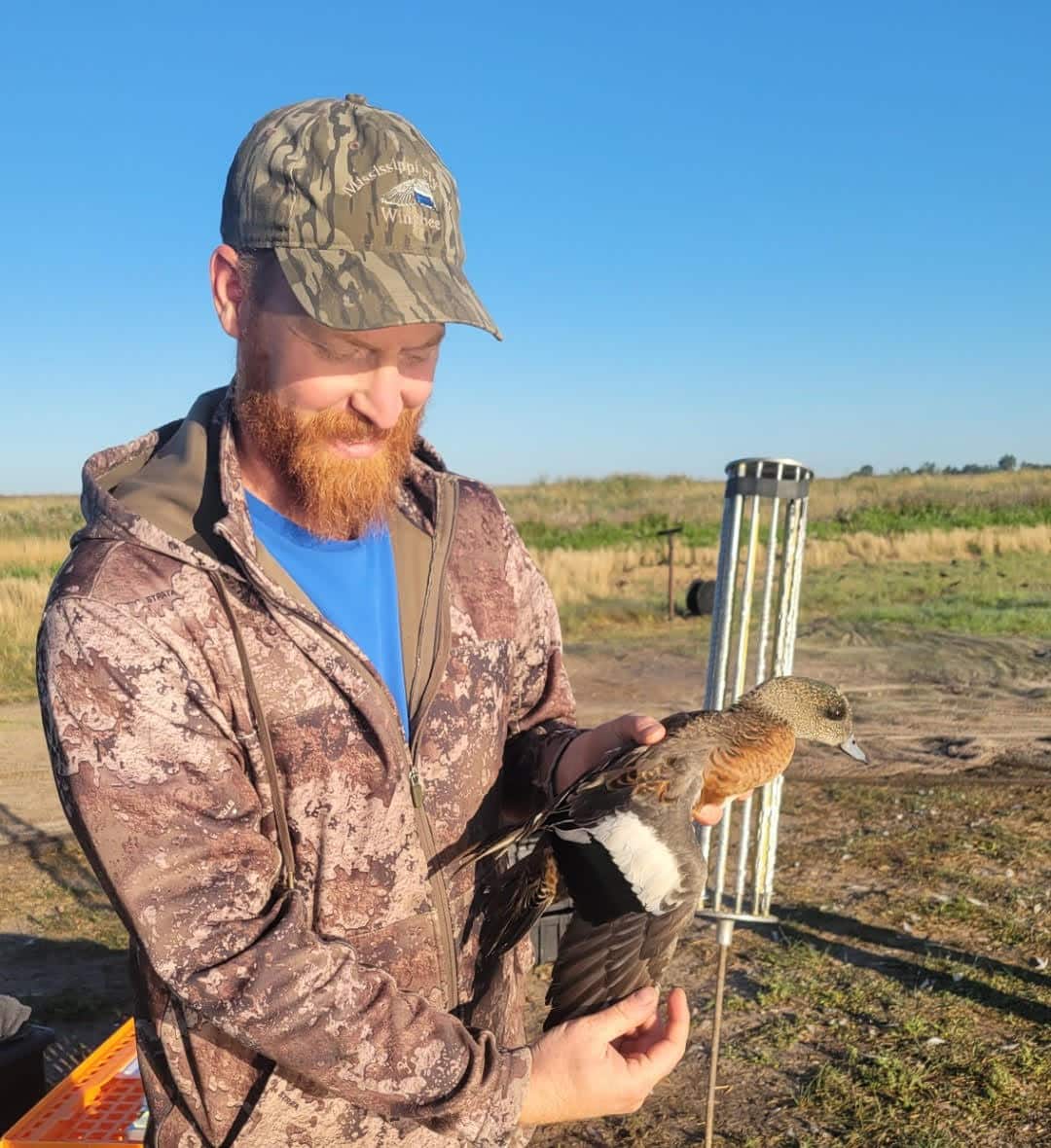
Things move so quickly that bands are already sorted by category, and biologists categorize each bird, clamp a band around its leg and release it on the spot.
“A few birds that meet certain research criteria may be held back for different work while we’re there,” Guy said. “A few had some blood drawn for avian influenza testing, and a few others were outfitted with different types of GPS locators for a study being done by the University of Saskatchewan, but all the others were released as soon as we had a band on them.”
During the course of two months, the banding crews banded 5,826 ducks.
Guy says the banding effort went about as smoothly as anyone could hope. They fired at least one shot per day, banded, then set up other sites with bait to get ready for the next day’s shot.
“We did have one incident with a rancher whose cows found the barley while we were trying to bait the site,” he said. “They’d eat it all before the ducks had a chance to get there, so we put up a small barbed-wire fence around the site, but they managed to push through it a couple of times. We finally got serious about the fence and ran three stands of wire and tightened them up. Of course, the rancher came to move the cows the next day anyway.”
Guy says the biggest takeaway from the experience was just how critical the refuge system and conservation incentive programs are in this portion of the Prairie Pothole Region.
“You have these large refuges that are playing a huge role in providing waterfowl nesting areas, but there’s so much of the land that is in agriculture, either cropland or grazing land,” Guy said. “It really hits home with just how important Farm Bill programs are that incentivize people to leave land for conservation. Seeing it firsthand, you can see just how much habitat is lost to conversion, and how a drought year really affects the birds. I’m just happy to help with collecting this data which is so vital to waterfowl management.”
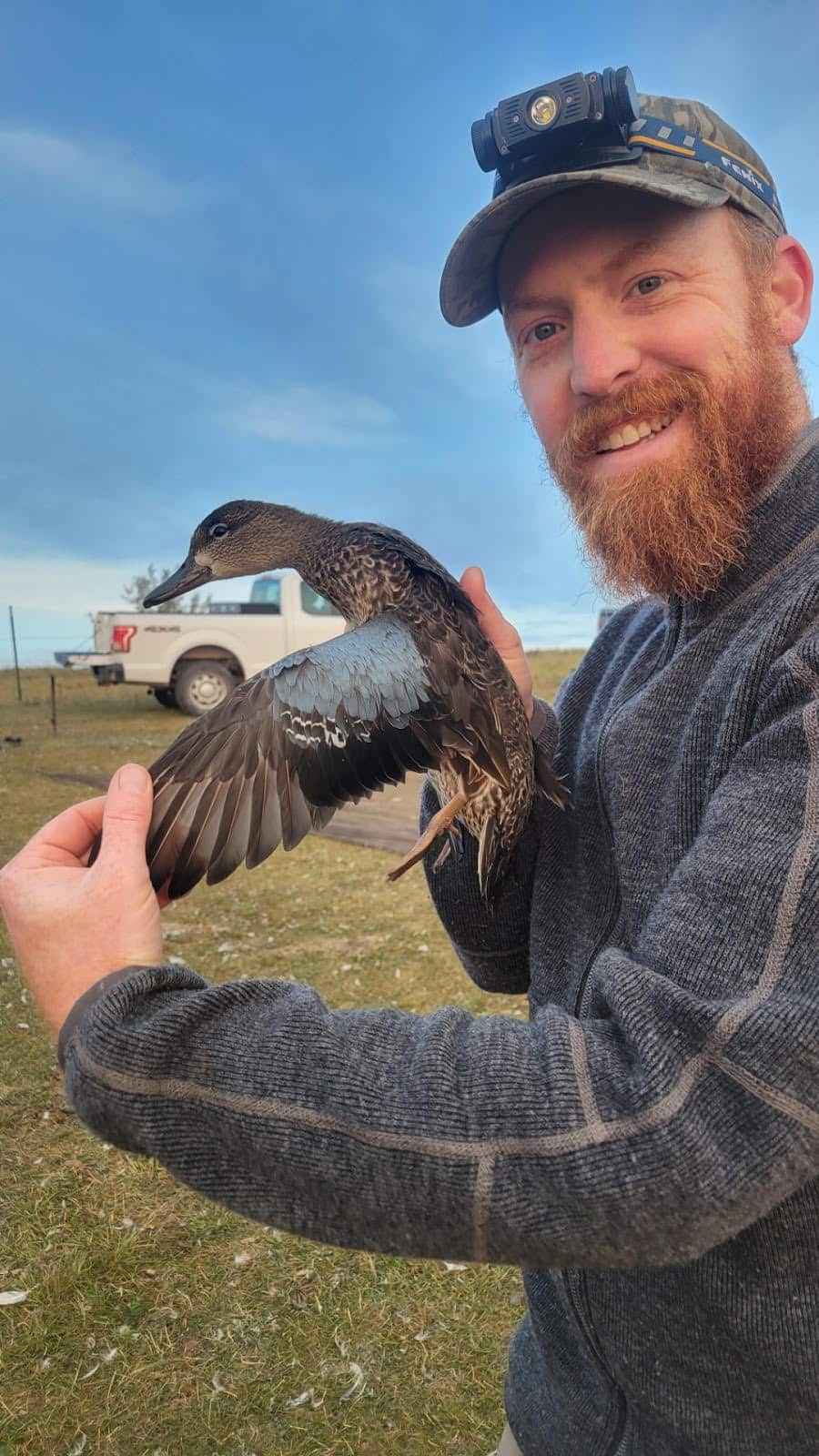
Guy won’t just be watching the skies this waterfowl season, either. He hopes that maybe he’ll be lucky enough to take a banded bird and be a part of the recovery portion of this ages-old conservation mission.
“That’s really a dream of anyone who’s been up there banding ducks: to get one of the birds you caught months or years before at the other end of the country,” Guy said.
If you harvest a banded bird, please report it at www.reportband.gov.
####
CUTLINES:
MALLARD
AGFC biologist Cayce Guy takes a minute with a male mallard that’s not yet in its breeding plumage to take a photo in the Prairie Pothole Region. Photo courtesy Cayce Guy.
NET SET
Rocket nets set behind a barley bait site ready to capture hundreds of waterfowl for banding and research. Photo courtesy Cayce Guy.
BIRDS ON BAIT
Banding crews spend time mowing and baiting the site far enough from the water’s edge to keep all captured birds on the ground and out of the water during the capture process. Photo courtesy Cayce Guy.
GUY WITH BIRD IN FRONT OF STAND
AGFC biologist Cayce Guy with a male wigeon standing in front of a rack of presorted bands to speed up the banding process. Photo courtesy Cayce Guy.
GUY WITH BLUE-WINGED TEAL
AGFC biologist Cayce Guy with blue-winged teal banded in North Dakota. Photo courtesy Cayce Guy.
Recent News
Arkansas Wildlife Weekly Fishing Report
Mar. 19, 2026
Subscribe to Our Weekly Newsletter E-mails
Don’t miss another issue. Sign up now to receive the AGFC Wildlife Weekly Newsletter in your mailbox every Wednesday afternoon (Waterfowl Reports are published weekly during waterfowl season and periodically outside the season). Fishing Reports arrive on Thursdays. Fill in the following fields and hit submit. Thanks, and welcome!