Dave Donaldson Black River (DDBR) Renovation Plan
Latest Dave Donaldson Black River (DDBR) Renovation Plan Updates:
- On March 5, 2026 a public meeting was held at the Black River Technical College in Pocahontas. During the meeting, AGFC staff presented updated WMA plans for the renovation of infrastructure and greentree reservoirs in northeast Arkansas. Click here to view the presentation PDF.
- On Feb. 10, 2025 two public meetings were held in Pocahontas and Jonesboro.
- On Dec. 7, 2024 AGFC held a virtual public meeting to discuss the project plan and to answer questions from the public. Click here to view.
- On Nov. 30, 2024, AGFC Chief of Wildlife Management Luke Naylor gave a presentation on the updates for the project for the monthly commission meeting. Click here to view.
Dave Donaldson Black River (DDBR) Renovation Plan
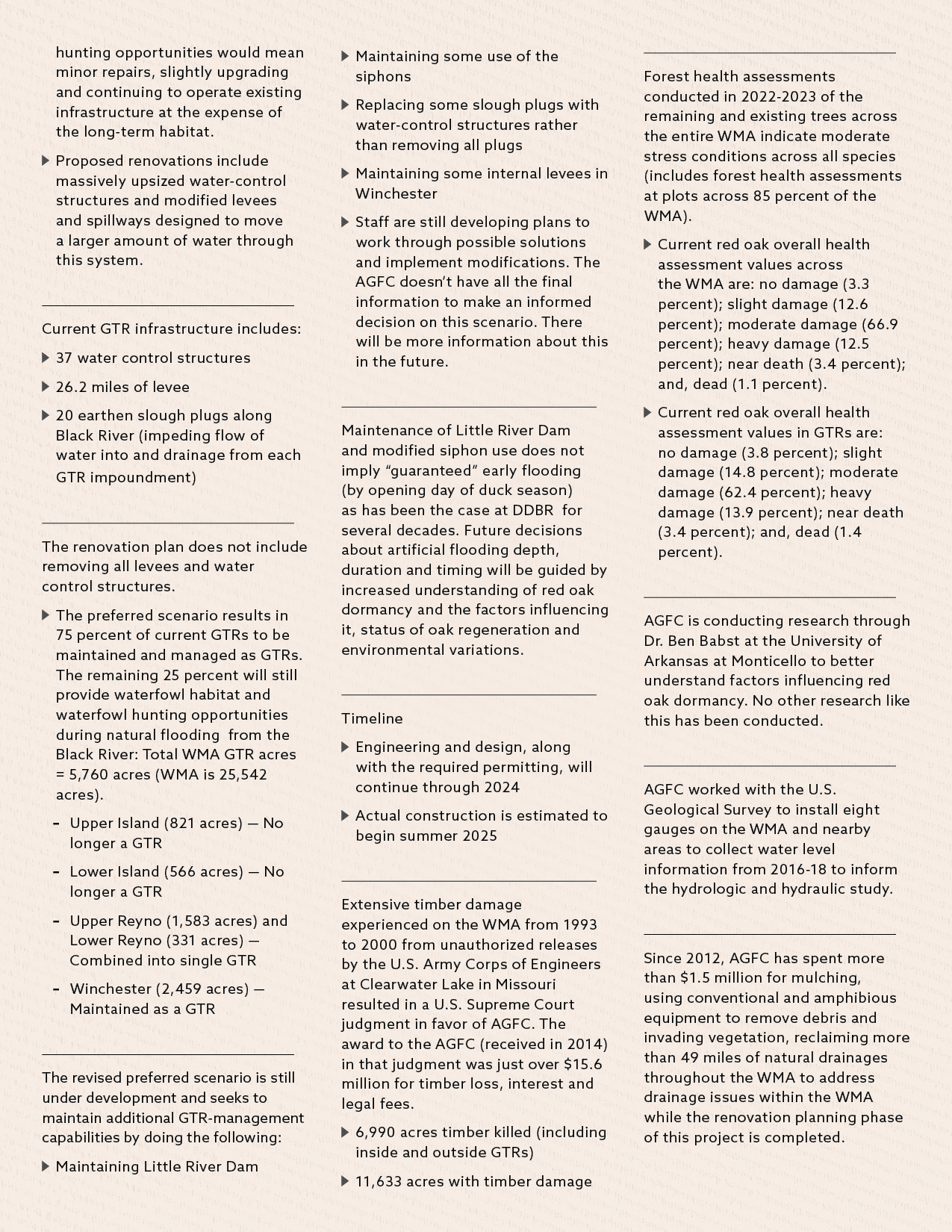
Dave Donaldson Black River WMA covers roughly 36.7 square miles of forested landscape in northeast Arkansas that provides critical winter habitat for waterfowl and many migratory bird species as well as year-round habitat for a host of resident wildlife, including white-tailed deer, squirrels, rabbits and a robust nongame wildlife population. AGFC Chief of Wildlife Management Luke Naylor presented an overview of the survey work and hydrological modeling conducted over the last two years in cooperation with Ducks Unlimited and outside contractors to determine what structures need to be improved or removed to increase the area’s ability to drain when allowed by the Black River to improve forest health on the area.
“Historically, many of the structures have been trying to fight the water, and water always wins,” Naylor explained. “These modifications will work with what nature already wants to do to offer waterfowl habitat in a sustainable way for our bottomland hardwoods.”
Armed with the new models and knowledge, the AGFC has been working with outside contractors to design plans for engineers. Those plans are expected to be complete in 2024. Construction is expected to begin in 2025 and should take roughly five years, pending weather and site conditions. Naylor and AGFC Director Austin Booth stressed that the area would not see large-scale closures during waterfowl seasons during the construction.
“The Black River is still going to flood, there’s no stopping that,” Naylor said. “Just like we saw last year at Henry Gray Hurricane Lake WMA with all structures removed – That water is going to pulse in and flood it, and the ducks and hunters will find it. Our design is focused on reducing only the artificial flooding capacity and increasing drainage of the area to make sure the bottomland hardwood forest is sustained in the long-term.”
Resources
For more information about this WMA, please visit:
Below you can find more information regarding the closure of these areas and the standards that demonstrate the agency’s commitment to responsible forestry and building better habitats across our natural state:
Black River Wildlife Management Area – Current Forest Management Summary
Current forest management is occurring on sites categorized utilizing the Arkansas Wildlife Action Plan land classification system for terrestrial habitats. Treatment sites in this area are classified as Lower Mississippi River Low Bottomland Forest and Cultivated Forest.
Low bottomland forests are usually seasonally flooded in back swamps, with flooding more frequent than every 5 years, usually more frequently than every two years, generally by still water that may be impounded behind natural levees, and are classed as Low Gradient Riverine Backwater wetlands in hydrogeomorphic classifications. Low bottomlands occur along the Mississippi River and its tributaries in the Mississippi Alluvial Plain Ecoregion. Prolonged flooding dominates this system, and its duration is greater than in the adjacent Mississippi River Riparian Forest. Overcup oak and willow oak are the characteristic dominant species. Soils are clayey with poor internal drainage. Historically, regeneration was through small treefall gaps or large tornado tracks.
Cultivated forests include plantations primarily composed of Nuttall’s Oak, with regularly spaced trees planted for reforestation and are subject to periodic silvicultural maintenance. Management at the stand level differs based on the type of cultivated forest present at the area. Objectives of reforestation are to restore the site to a bottomland hardwood forest with site appropriate species. In order to ensure appropriate red oak species can sustain, it is required to implement forest management that includes the targeted removal of less desirable species.
Maple Slough
Overcup oak, Nuttall oak, and Baldcypress are the dominant species by order of prevalence. Recent forest health data indicate red oak species are exhibiting moderate to heavy stress throughout all of the stand. Sugarberry, Green ash, and Swamp privet are the most prevalent sub-merchantable species. Wind throw and mortality of dominant and co-dominant trees due to water stress have provided favorable conditions for limited regeneration of Nuttall oak and Willow oak.
Crane Roost
Nuttall oak, Overcup oak, and Green ash are the dominant species by order of prevalence. Recent forest health data indicate red oak species are exhibiting moderate stress throughout the entire stand. Swamp privet, Persimmon, and American elm are the most prevalent sub-merchantable species. Wind throw and mortality of dominant and co-dominant trees due to water stress have provided favorable conditions for limited regeneration of Nuttall oak and Willow oak.
Mill Lake Wetland Reserve Easement
Nuttall oak, Sweetgum, and Eastern Red Cedar are the dominant species by order of prevalence. Recent forest health examination indicates that red oak species are under no to slight stress throughout the entire stand. Sweetgum, Nuttall oak, and Eastern Red Cedar are the most prevalent sub-merchantable species. Extreme understory and midstory growth of Sweetgum and Eastern Red Cedar has caused a reduction in the growth of red oaks. Regeneration of red oak species has been limited due to the lack of sunlight on the understory.
Silvicultural techniques will be the primary tools utilized to manipulate forest structure and species composition in order to provide favorable conditions for red oak regeneration, improve forest health and achieve Desired Forest Conditions (DFCs), which will result in increased cover and species diversity on the ground. DFCs are predetermined forest metrics including canopy closure, mid-story density, species composition and basal area that are appropriate for a specific land classification. The desired conditions vary by land classification and are designed to ensure forest sustainability and diverse species composition appropriate for the site.
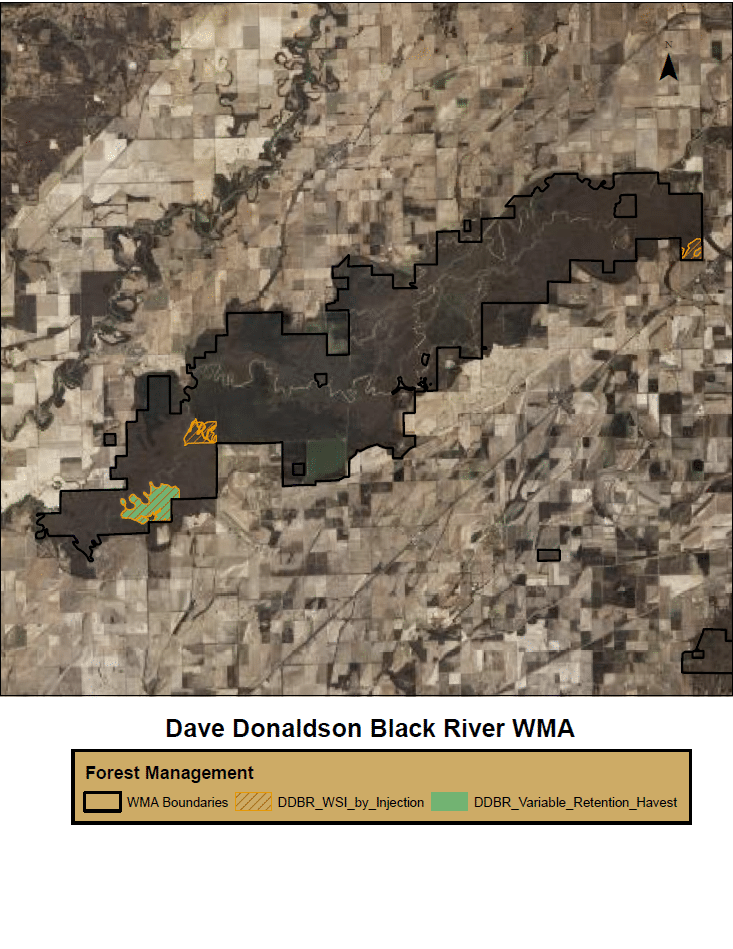
- Timber marking – 432 acres (performed 2025)
- WSI single stem injection – 599.64 acres (performed 2025)
- Variable retention harvest – 432 acres ( to be performed in 2026-2027)
- WSI single stem injection – 94 acres
The Arkansas Wildlife Action Plan identifies species of greatest conservation need for Arkansas. SGCN are species that are rare, declining, or for which we have very little information on population status.
The identification of SGCN is part of a process to identify species and groups of species that will be the focus of programs and projects supported by federal funding under the State Wildlife Grant program. Federally-listed species that occur in Arkansas are included on the list of SGCN and addressed by this strategy. These species are also eligible for funding through cooperative endangered species act Section 6 grants.
SGCN known from Dave Donaldson Black River WMA:
- Indiana Bat (Myotis sodalis)
- Northern Long-Eared Bat (Myotis septentrionalis)
- Little Brown Bat (Myotis lucifugus)
- Ozark Fanshell (Cyprogenia aberti)
- Pink Mucket (Lampsilis abrupta)
- Purple Fringeless Orchid (Platanthera peramoena)
- Yellow-crowned Night-Heron (Nyctanassa violacea)
- Yellow-billed Cuckoo (Coccyzus americanus)
- Chimney Swift (Chaetura pelagica)
- Wood Thrush (Hylocichla mustelina)
Fiscal Information
| Fiscal Year | All WMAs | Dave Donaldson WMA |
|---|---|---|
| 2016 | 332,915.16 | 12,796.36 |
| 2017 | 332,915.16 | 15,513.63 |
| 2018 | 83,228.79 | 0.00 |
| 2019 | 642,687.13 | 41,772.00 |
| 2020 | 629,975.64 | 35,189.00 |
| 2021 | 747,201.78 | 53,438.00 |
| 2022 | 719,037.93 | 58,718.00 |
| 2023 | 831,776.80 | 74,393.00 |
| 2024 | 800,335.40 | 143,250.00 |
| Grand Total | 5,120,073.79 | 435,069.99 |
| WMA | Acres | Year Completed | Plant Labor | Mechanical | Chemical | Seedlings |
|---|---|---|---|---|---|---|
| Harris Brake | 200 | 2011 | $5,500.00 | $4,400.00 | ||
| Raft Creek | 100 | 2011 | $5,436.00 | |||
| Ed Gordon | 81 | 2012 | $5,297.40 | $4,415.00 | ||
| Richland Valley | 14 | 2013 | $1,092.50 | $557.50 | ||
| Galla Creek | 62 | 2013 | $3,372.80 | $4,910.00 | ||
| Ed Gordon | 81 | 2013 | $4,414.50 | $4,415.00 | ||
| Hurricane Lake | 2018 | $12,300.00 | ||||
| Gene Rush | 35 | 2020 | $3,500.00 | $4,550.00 | $1,312.50 | $5,633.00 |
| Richland Valley | 20 | 2021 | $1,359.00 | $2,868.00 | ||
| Hurricane Lake | 225 | 2022 | $37,125.00 | |||
| Hurricane Lake | 2022 | $1,890.00 | ||||
| 818 | $29,972.20 | $4,550.00 | $38,437.50 | $41,388.50 | ||
| WMA | Acres | Year Completed | Plant Labor | Mechanical | Chemical | Seedlings |
| Lake Overcup | 53 | 2023 | $5,830.00 | $4,795.68 | ||
| Hurricane Lake | 107 | 2023 | $7,115.50 | |||
| Hurricane Lake | 164 | 2023 | $24,436.00 | |||
| Hurricane Lake | 61 | 2023 | $9,000.00 | |||
| Hurricane Lake | 2023 | $4,225.00 | ||||
| 385 | $21,945.50 | $24,436.00 | $9,020.68 |
| Year | Reforestation Expenditure |
|---|---|
| 2010 | $0.00 |
| 2011 | $15,336.00 |
| 2012 | $9,712.40 |
| 2013 | $18,762.30 |
| 2014 | $0.00 |
| 2015 | $0.00 |
| 2016 | $0.00 |
| 2017 | $0.00 |
| 2018 | $12,300.00 |
| 2019 | $0.00 |
| 2020 | $14,995.50 |
| 2021 | $4,227.00 |
| 2022 | $19,222.50 |
| 2023 | $55,402.18 |
Maps

Frequently Asked Questions
The total amount spent on infrastructure at Dave Donaldson in the last 5 years is $2,239,976.25. This includes:
- AGFC worked with Ducks Unlimited to deliver a wetland renovation project on the Brookings Waterfowl Rest Area using North American Wetlands Conservation Act funding ($848,948).
- AGFC installed a new pipe and screwgate to facilitate management of the Brookings GTR ($29,198.75).
- AGFC worked with Ducks Unlimited for surveys,modeling and design of Water Control Structures on DDBRWMA, total spend YTD is $1,087,781.09.
- Payroll for the past 5 years related to infrastructure maintenance ($136,038.15).
- Datto Access Parking Lot Expansion ($8,000.00)
- Installation of wells/pumps at Lake Ashbaugh ($130,010.26)
Contractors are utilized to conduct both beaver control and drainage maintenance on all wetland WMAs across the state. This includes the removal of beaver dams, debris and other obstructions in canals, sloughs and other natural drainages on these WMAs. The expenditures below cover both beaver removal and drainage maintenance and are not solely for beaver removal. Activities are conducted primarily during the months of April through October to maximize drainage of the WMAs during the growing season.
Please note that some invoices did not have enough data to distinguish how much is for Dave Donaldson Black River WMA versus other WMAs. The amount spent on beaver control and drainage maintenance on Dave Donaldson WMA in the last 5 years (Fiscal Years 2019-2023) is $263,510 with an additional $143,250 spent as of December 12, 2023 in Fiscal Year 2024.
We historically had a contract for running a relift pump which expired in 2021, making the answer $0, since we didn’t have a pump contract this year.
The last year for the pump contract was calendar year 2021 at a cost of $27,000 per year. The 2022 bid price for the renewal of that pump contract was a five year contract for $275,000, which is when AGFC declined to continue the contract.
The total cost is $173,890.00 (RP).
The contractor provided the material, labor, machinery, & tools necessary to perform repair work at the Jack Cox Scatter Creek Firing Range and performed such work in accordance with the drawings dated 6-22-2022. The work to be performed by the contractor included the following:
- Fine grading of site to +/- 1” of finish grade
- Furnish and grade new topsoil
- Grade Road from the archery range to the drive of the parking lot entrance of the range pavilion. This includes furnishing and installing limestone Class 7 rock as needed as well as B-stone for erosion control.
- Replace existing culvert with 36″ HDP pipe.
- Replace roof and roof insulation in its entirety.
- Remove both existing no-blue-sky baffles. The complete set of existing A500 steel frames are to be handed over to the AGFC. The existing baffle material is to be trucked away and disposed of.
- Cut off all existing target frame pins.
- Construct a new a dirt bunker behind the 10 yard and 25 yard lines.
- Demolish and pour a new crosswalk at the 25 yard line & 50 yard line.
- Demolish and pour a new crosswalk at the existing area located between the 10 yard & 25 yard lines at the West boundary.
- Clean off/remove dirt build up along the entire length of the 100 yard crosswalk.
- Clean off/remove dirt build up along the entire length of the 150 yard crosswalk.
- Clean off/remove dirt build up along the entire length of the 200 yard crosswalk.
- Regrade the entire range area. This includes to haul in and spread topsoil as needed.
- Construct a new dirt berm bunker to run parallel to the existing 10 yard line.
- Construct a new dirt berm bunker to run parallel to the existing 25 yard line.
- Mechanically compact the existing dirt backstop for the range. Furnish and install new coconut cloth over this entire area for erosion control.
- Add Rail Road tie berm with silt screening at base of backstop.
- Add new Rail Road tie crosswalk protection berms at all existing crosswalk locations. There are six (6) locations total. All ties shall be new hardwood treated hardwood ties in accordance with railroad standards
- CONTRACTOR is responsible for their own construction layout and staking to properly construct.
- CONTRATOR is responsible to safely and accurately install all landscape materials that adjoins to landscape elements of the project.
- CONTRACTOR is responsible for all heavy machinery needed for the project.
- CONTRACTOR is responsible for the delivery and unloading costs of all materials.
- The contract shall include all State, County, and applicable sales tax.
- All work shall be performed using best practices and meet or exceed State & City code requirements.
- All work shall be performed to OSHA safety standards.
- The contractor is responsible to clean up work on a daily basis and is responsible for the overall cleanliness of the project.
- All work shall be straight, neat, plumb and level as applicable. Likewise, industry best practices shall be used at all times
The amount of money spent on upgrading structures and levee system at the Dave Donaldson WMA for the last 10 years is $2,506,999.05.
Out of the total amount spent, $848,948 were grant funds that Ducks Unlimited received and spent on Dave Donaldson WMA.
These upgrades include:
- AGFC installed a new pipe and screwgate to facilitate management of the Brookings GTR ($29,198.75).
- AGFC worked with Ducks Unlimited to deliver a wetland renovation project on the Brookings Waterfowl Rest Area using North American Wetlands Conservation Act funding ($848,948) and AGFC funds ($164,904).
- Surveys, hydrology data collection and modeling and engineering for developing infrastructure renovation plans ($1,628,852.30)
- Other expenditures on GTR infrastructure are limited to regular maintenance and upkeep of existing infrastructure. No major upgrades to water control structures and levees have been initiated or completed in the last 10 years.
Contractors are utilized to conduct both beaver control and drainage maintenance on all wetland WMAs across the state. This includes the removal of beaver dams, debris and other obstructions in canals, sloughs and other natural drainages on these WMAs. The expenditures below cover both beaver removal and drainage maintenance and are not solely for beaver removal. Activities are conducted primarily during the months of April through October to maximize drainage of the WMAs during the growing season. Please note that some invoices did not have enough data to distinguish how much is for DDBR WMA versus other WMAs.
- Statewide expenditures on beaver control and waterway maintenance since July 1, 2023 exceed $800,000.
- Expenditures on the same activities at Dave Donaldson Black River WMA since July 1, 2023 exceed $150,000.
See full table of beaver eradication expenditures at the bottom of the page.
$0; all expenditures have been on design and planning for future renovation.
Tree planting is utilized by AGFC to re-establish trees within fields or in areas within GTRs where there has been complete mortality of all desirable overstory species. The planting activities below at Galla Creek and Hurricane Lake WMAs were within GTRs. The preferred method to re-establish desirable forest composition is through natural regeneration from existing desirable overstory species in which case no replanting would be necessary.
See full table of reforestation expenditures for more information.