Midwinter Numbers Take a Tumble: Aerial survey count of Delta notes 544,705 total ducks in early January
BY Jim Harris
ON 01-21-2026
Aerial counts Jan. 5-13 for the Arkansas Game and Fish Commission’s midwinter survey seemed to fall in line with what has been expressed anecdotally by the public around The Natural State concerning waterfowl numbers. In fact, the midwinter survey, which is usually when biologists see peak waterfowl numbers, had lower counts this year than for the midwinter survey in 2025, according to the survey report released this week by Brett Leach, the AGFC’s waterfowl program coordinator.
And the best numbers seemed to be found in the Bayou Meto-Lower Arkansas River area during the survey period.
AGFC biologists conducting transect-based surveys in the Arkansas Delta estimated 334,110 mallards and 544,705 total ducks. The Delta mallard population estimate was 117,908 mallards below the 2025 MWS estimate and 427,502 mallards below the 2010-2025 MWS long-term average.
Total duck population estimates were 137,386 birds below 2025 MWS estimates and 640,394 birds below the long-term average.
“Mallards typically account for about 63 percent of all ducks in the Delta during the midwinter survey, and this survey period was very similar, with 61 percent of the total duck estimate being mallards,” Leach wrote in his report.
Arctic goose population estimates totaled 1,409,809 light (lesser snow and Ross’s) geese and 466,550 greater white-fronted geese in the Delta. That’s about 700,000 fewer estimated snows, blues and Ross’s from the mid-to-late-December survey, but 100,000 more specklebellies. Biologists have long noted that goose counts tend to be less accurate because of the way geese in groups react to the survey planes flying 500 feet overhead. Ducks tend to stay in place and can be estimated earlier.
Duck population estimates in the Arkansas River Valley via the transect-based survey method totaled 24,110 ducks, including 15,985 mallards. Staff performing cruise surveys in southwest Arkansas reported an estimated 6,125 ducks, with 1,805 of those being mallards. Biologists are back in the sky this week (as long as the weather holds up) for the annual late January survey, the last of three AGFC waterfowl surveys for the season.
Hot zones
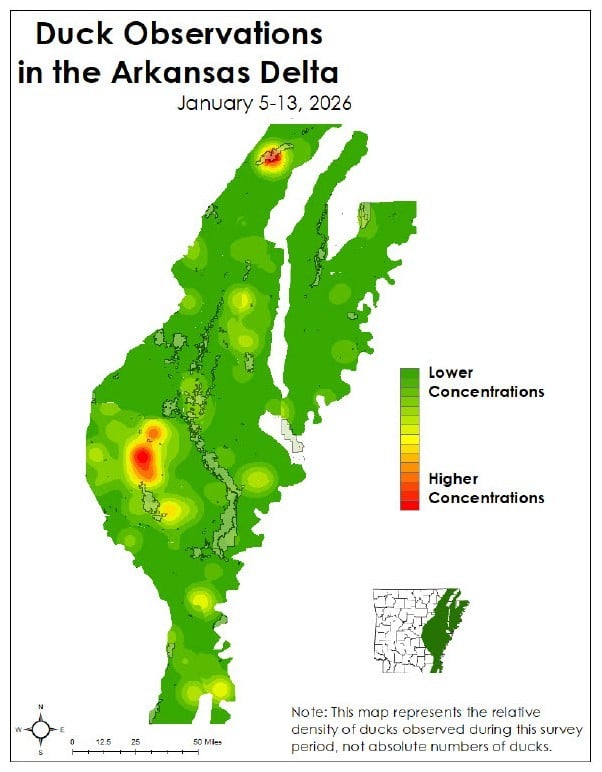
Most notably in the midwinter survey, biologists estimated more than 140,000 mallards in the Bayou Meto-Lower Arkansas River survey zone. The Bayou Meto-Lower Arkansas survey zone alone accounted for 43 percent of the Delta-wide mallard estimate and 32 percent of the total duck estimate.
This was followed by the Lower White River, Black River-Upper White River and Cache River survey zones, which had an estimated 33,000-38,000 mallards. Hot spot maps indicate several key duck concentration areas primarily in the central and far northern portions of the Delta.
Biologists were able to get in the air in the Arkansas River Valley this survey period, after being sidelined by airplane maintenance problems, and mallard estimates were 34 percent below the midwinter survey long-term average, while total duck estimates were 48 percent below the long-term average. Mallards made up 66 percent of the total duck estimate in the River Valley, 15 percent higher than the long-term average.
Most of the mallards (81 percent) were estimated in the Point Remove-Plumerville survey zone. Total duck estimates were highest in this survey zone, which accounted for 62 percent of the total ducks estimated. Hot spot maps highlight key concentration areas primarily in the Point Remove Plumerville survey zone.
Way down in the southwest
Duck numbers in southwest Arkansas remain significantly lower than normal. Mallard counts trailed the midwinter long-term average by 84 percent, while total duck populations were 75 percent below average. Of the mallards recorded, the majority (52 percent) were concentrated along the Red River between U.S. Highway 82 and the Sulphur River.
Still dry all around
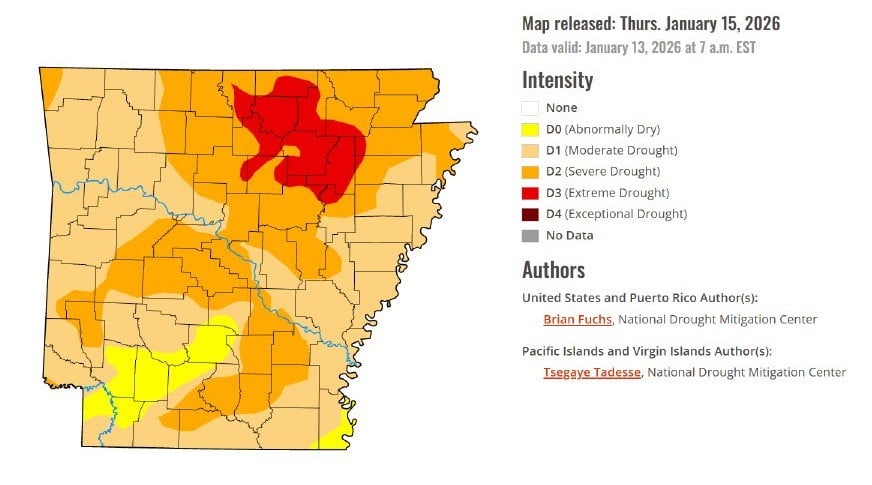
Arkansas continues to face extremely dry conditions this winter with very little rainfall. Many regions of Arkansas faced their second-to-third driest December on record, dating back to 1893, and there has been little precipitation in January. Since the last aerial survey report, many regions of Arkansas have been classified as having moderate to severe drought conditions.
Leach and AGFC Wildlife Management Division employees Jason Jackson, Tristan Bulice, William Guy and Derek Furr conducted the 2026 midwinter survey in the three regions.
###
CUTLINES:
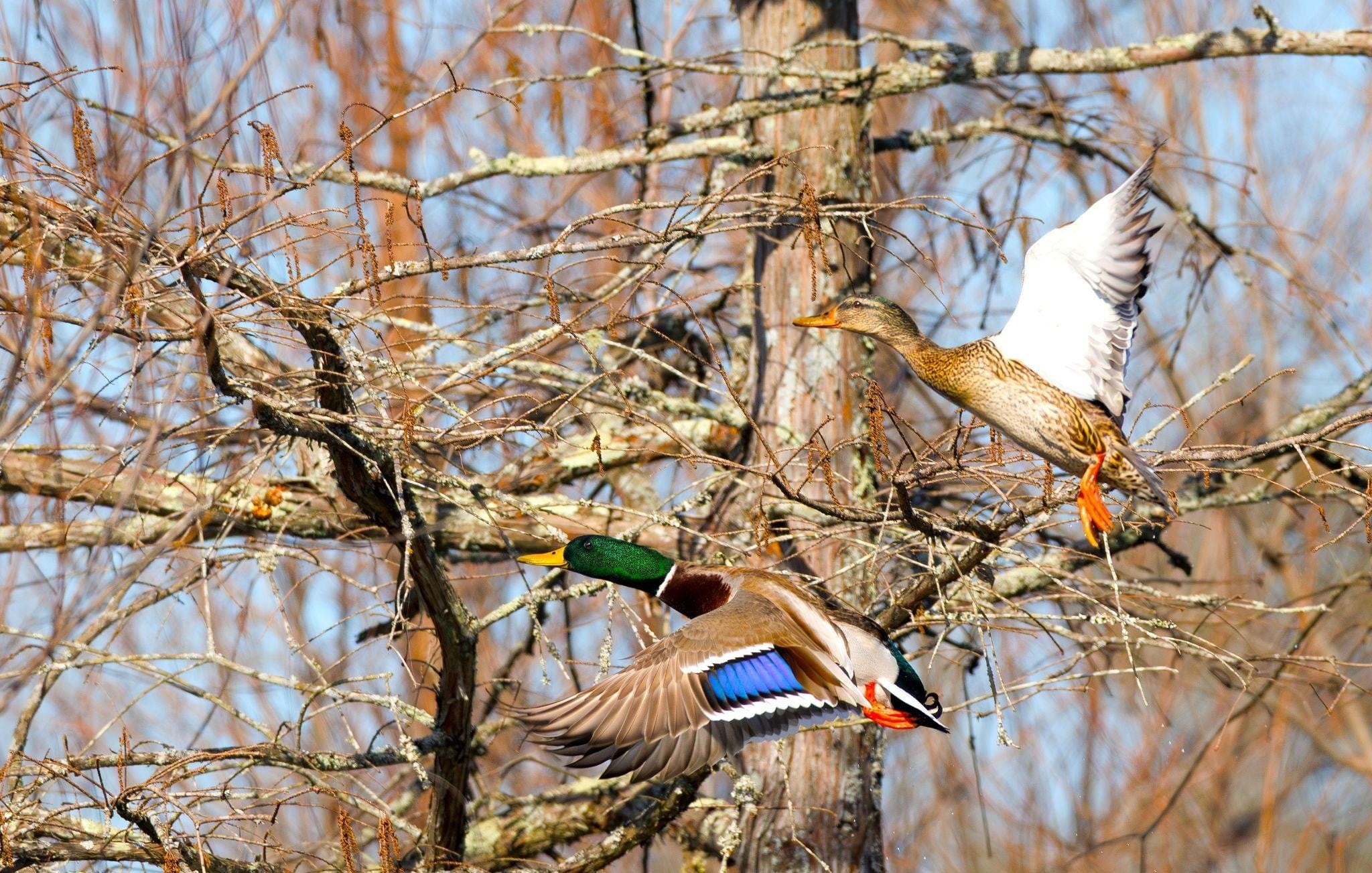
(1) A mallard drake and hen fly into flooded timber in southeast Arkansas. More mallards appear to be pair-bonding this past week according to anecdotal reports from hunters in the field in eastern Arkansas.
(2) The total duck estimated count map of the Arkansas Delta (shown in the first map) reflected the mallard estimate areas seen by AGFC biologists.
(3) Drought conditions have gotten worse over Arkansas in the first half of January, according to the national drought map, with a larger area of extreme (red) and severe (darker brown) conditions as of Jan. 15.
Recent News

Subscribe to Our Weekly Newsletter E-mails
Don’t miss another issue. Sign up now to receive the AGFC Wildlife Weekly Newsletter in your mailbox every Wednesday afternoon (Waterfowl Reports are published weekly during waterfowl season and periodically outside the season). Fishing Reports arrive on Thursdays. Fill in the following fields and hit submit. Thanks, and welcome!