Mallard Estimates Jump in Delta: AGFC’s delayed December aerial survey shows significantly better numbers than this time last year
BY Jim Harris
ON 12-31-2025
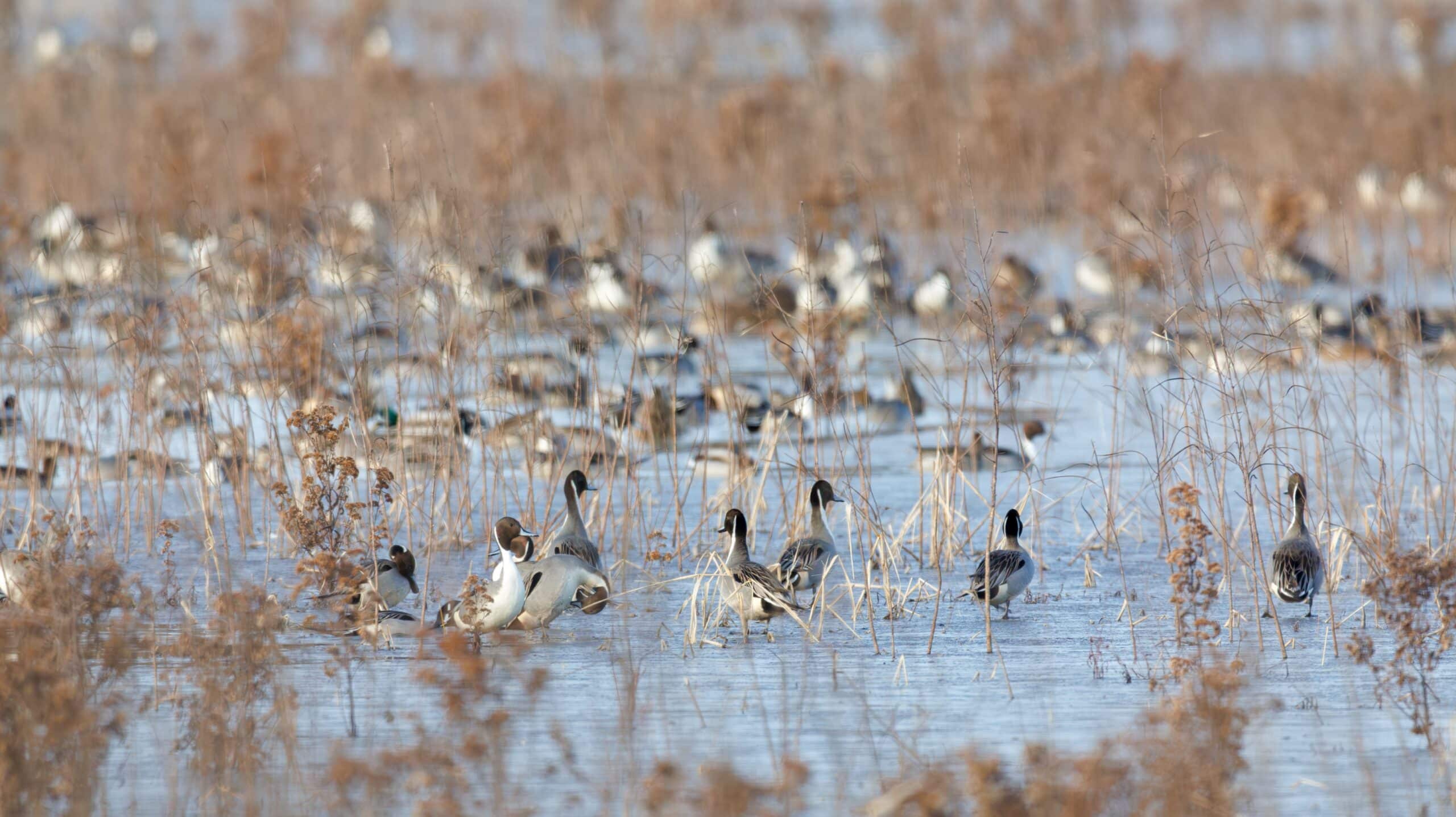
Arkansas Game and Fish Commission biologists conducting transect-based surveys from Dec. 15-23 in the Delta estimated a mallard count that was 344,741 birds above a meager December 2024 count, with an estimated 498,164 seen. That total estimate is 35,154 mallards below the 2009-2024 December long-term average, according to Brett Leach, the AGFC’s waterfowl program coordinator.
Total ducks in the Delta numbered 928,377 ducks over the same December estimate last year, with a total of 1,458,354 ducks estimated, Leach said in his report issued this week. The total was 407,455 ducks over the estimated long-term average for the December survey.
Arctic goose population estimates totaled 2,992,914 light (lesser snow and Ross’s) geese and 285,292 greater white-fronted geese in the Delta.
Weather and aircraft maintenance delays led to a later-than-usual December estimating period, which didn’t wrap up until right before Christmas for the Delta. Equipment problems with aircraft scratched the annual December count for the Arkansas River Valley, but Leach said the River Valley is scheduled to be flown next week for Arkansas’s annual mid-winter survey.
Staff also performed a cruise survey Dec. 10 in southwest Arkansas and estimated 7,960 total ducks, with 3,710 of those being mallards. Duck numbers in that region remain significantly lower than historical norms. Mallard counts trailed the December long-term average by 69 percent in southwest Arkansas, while total duck populations were 74 percent below average. Of the mallards recorded, the majority (61 percent) were concentrated along the Red River between U.S. Highway 82 and the Sulphur River.
On average in the Delta, mallards account for about 49 percent of all ducks during December surveys. During this survey period, mallards made up only 34 percent of the total duck estimate, a similar trend for recent, dry Decembers in The Natural State.
“During periods of drought, estimates may be biased high or low due to the clumped distribution of birds around limited water sources, introducing greater uncertainty into the estimates,” Leach wrote in his report. “This spatial clustering, evidenced by observer reports of large concentrations along specific transects, likely biased our estimates upward. The resulting uncertainty is reflected in the wide confidence intervals; for instance, the mallard estimate of 498,164 had a confidence interval of 297,292 to 797,901 birds, suggesting the true number of mallards in this region could range from about 297,000-798,000 birds.”
He wrote that similarly, because of the clustering of birds around limited water sources, the total duck estimate had a wide confidence interval of between 817,000 to 2.31 million birds. “Consequently, confidence in these population estimates is lower than typical surveys,” he stated.
Leach said the biologists estimated over 50,000 mallards in four survey zones: the Bayou Meto-Lower Arkansas, Big Creek in eastern Arkansas, Cache and L’ Anguille rivers. These survey zones accounted for 79 percent of the MAV-wide mallard estimate and 76 percent of the total duck estimate. In addition, the Black-Upper White survey zone had a relatively high total duck estimate of 106,953.
Most notably, the Big Creek zone had 429,157 total ducks, which made up 29 percent of the total duck estimate.
Hot spot maps indicate several key duck concentration areas primarily in the central to east-central portion of the Delta.
The report noted that the Delta has faced extremely dry conditions this fall without any substantial rainfall, with the majority of the region currently classified as moderate to severe drought conditions. Observed rainfall totals in November and December were about 62 percent below normal in central Arkansas.
Leach wrote in his report: “While the current forecast includes light precipitation after the New Year, it lacks the volume necessary to alleviate the deficit. Early in the survey period, icy conditions caused ducks to congregate in tight clusters; however, subsequent warming allowed the birds to disperse across the landscape a bit more.”
AGFC Wildlife Management Division employees Tristan Bulice, Casey Guy and Derek Furr conducted the first aerial survey of the season, with Bulice and Guy flying the Delta. Leach said he will be joining them next week to fly the Arkansas River Valley. Surveys are scheduled to begin Jan. 5. To see the latest survey and the maps of duck distribution around the state, click HERE.

* Don’t let the New Year’s Day college football playoff games and other excitement (or the recuperation from too much New Year’s Eve) cause you to forget that the AGFC’s permit application process will be active for hunting the following weekend starting Thursday at 3 p.m. and concluding Sunday at midnight. The online permit application period covers public hunts on the AGFC’s 50 WRICE private fields as well as permitted hunts in several WMAs. Applications for the private land permit hunts on the WRICE leases and permits for hunting in certain WMAs can be made online at agfc.com under “Get a License,” or by clicking here. Winners will be notified on Monday with instructions and directions to their hunting locations.
* The sudden frigid temperatures that turned our balmy, Miami-like Christmas holiday into the North Pole chill we expect for this time of the year still didn’t seem to boost the anecdotal duck sightings, according to the AGFC’s Trey Reid, host of “Arkansas Wildlife TV” and the voice of the AGFC on several weekly radio and TV appearances. Reid said most of the hunters he spoke with reported few ducks even with the chilly mornings, though on Wednesday while reporting on KABZ-FM, 103.7 “The Buzz,” he did report hearing of success in the southeast part of the state, particular near Pine Bluff on private land near the Arkansas River. Also, former AGFC Commissioner Brett Morgan wasn’t bashful about letting folks know how good the hunting was for his party on Wednesday at George H. Dunklin Bayou Meto WMA, as they got their limit of mallards by 7:30 a.m. Bayou Meto is one of the areas of the state where the AGFC’s December aerial survey this week indicated a good number of ducks were observed. Brett Leach, the AGFC’s waterfowl program coordinator, said that Bayou Meto has some areas with good huntable water, even with the dry conditions that have affected much of the state this month.
* Speaking of water levels and habitat conditions for public lands, those numbers are available on the AGFC’s website, and the links are here: For both the AGFC’s greentree reservoirs and the moist-soil units, you can go to the “Waterfowl” page on the agfc.com website, and at the top of the page, just below the mallard drake in flight, are the links to the most up-to-date information. Click on the operations plans for either GTRs or moist-soil units at the top of that page for the updated figures. The numbers are updated on those pages only when new information is added from the field biologists; if there are no changes in levels or conditions, it is not updated.
* While it was springlike for Arkansas and throughout the South all the way to the Gulf of Mexico during the week of Christmas, Ducks Unlimited’s biologists reported that Indiana and Ohio in the Mississippi Flyway enjoyed better hunting with a thick layer of snow and ice — marshes and lakes frozen, rivers covered with flow ice, all of which helped the waterfowl harvest. For Indiana’s North Zone, it was mostly a focus on goose hunting opportunities; the central and southern zones of both states saw concentrations of mallards and other species crowding into available open water.
* Mississippi Wildlife, Fisheries and Parks released its December aerial survey results, which indicated the best estimate of mallards in five years (92,947 birds, almost double the count of December 2024, and just shy of 2020’s 99,767 mallards). Total ducks were estimated at 390,183, also the best count seen since 2020, when 410,365 were estimated, and a jump of almost 90,000 from the total ducks estimated last December. Their long-term averages are down, though: 18 percent down in mallards and 19 percent in total ducks.
“Wetland habitat abundance in the Mississippi Delta has increased since mid-November, particularly in the north, but overall wetland conditions were still below average for this time of year. Public lands are currently providing a large proportion of intensively managed waterfowl habitat, and as a result, ducks were seen responding to these properties and the surrounding areas in relatively high numbers compared to the rest of the Delta. Large concentrations of ducks were also observed using large complexes of managed water across multiple private properties. Icy conditions during most of this survey caused ducks to shift from shallow water to deeper wetlands or to “pack” into areas where concentrations of birds kept shallow water open overnight. A large portion of harvested agricultural fields have been disked, resulting in reduced food availability for waterfowl even if these areas eventually flood in late winter. Substantial opportunity remains for landowners and managers to capture rainfall with water control structures as winter continues and as more waterfowl migrate into the state. Flooded habitat availability was greatest in the northeast portion of the Delta, which also held the highest numbers of waterfowl observed.”
* Ducks Unlimited’s Chris Holmes reported that many Louisiana duck hunters had a successful first split this season — something that many there had not experienced in quite some time. “We’ve had a really good season so far. The weather generally cooperated, and the birds were here in good numbers throughout,” John Owen, who hunts near Venice, in the far reaches of southeast Louisiana, told Holmes. “It has warmed up quite a bit, but we’re still hoping for a good second split.” Sounds like we’ve heard this one before, though, with December aerial surveys: Scheduling conflicts and aircraft availability hindered the completion of the Louisiana Department of Wildlife and Fisheries’ December aerial survey as well. However, counts conducted in some areas resulted in encouraging news for the remainder of the season. “The 2025 December survey estimate of 1.66 million ducks in Louisiana’s coastal region and Little River Basin represents a 33 percent increase from the 1.24 million estimated in November, with all species but ring-necked ducks increasing from the November estimate,” says Jason Olszak, LDWF waterfowl study leader. Even though the December ringneck count was lower than the previous month, the November count of ringnecks was 100 percent higher than both the five- and 10-year averages. The largest total number of ducks (1,124,000) was found in the southwest region, followed by 315,000 in the southeast and 216,000 in the Little River Basin. “Waterfowl habitat in the [southwest] region increased substantially in the last month. The mostly dry agricultural fields that had been observed in November received precipitation, and with the assistance of pumping by landowners, the agricultural region as a whole was roughly 35 percent inundated. The duck estimate for southwest Louisiana is 60 percent higher than the November estimate and one percent higher than December 2024,” Olszak says. The southeast portion of the state saw a 24 percent decline in duck numbers from the November survey. A bright spot in the survey was a big increase in the number of ducks observed in the Little River Basin. “The duck estimate at LRB is 80 percent higher than November and 575 percent higher than the December 2024 estimate, when only 32,000 ducks were observed,” Olszak notes. The timing of the survey affects the numbers, Olszak admitted to Holmes.
Click HERE for All Waterfowl Dates and Limits
Recent News
Subscribe to Our Weekly Newsletter E-mails
Don’t miss another issue. Sign up now to receive the AGFC Wildlife Weekly Newsletter in your mailbox every Wednesday afternoon (Waterfowl Reports are published weekly during waterfowl season and periodically outside the season). Fishing Reports arrive on Thursdays. Fill in the following fields and hit submit. Thanks, and welcome!