Wildlife Rehabilitation
Rehabilitating Wildlife in Arkansas
The Arkansas Game and Fish Commission oversees a system of rehabilitators that take in sick, injured or orphaned animals and rehabilitate them for release back into the wild. These wildlife rehabilitators must be experienced in the care of wild animals and have a veterinarian working with them to provide advice. A wildlife rehabilitation permit is required to provide medical care for injured wildlife or to raise orphaned wildlife for release back into the wild. The Arkansas Game and Fish Commission regulates rehabilitation of wildlife other than birds, and the U.S. Fish and Wildlife Service regulates rehabilitation of birds. Please keep in mind that:
- Rehabilitators are not AGFC employees.
- Rehabilitators are volunteers who receive no compensation for their services; they do this out of the goodness of their hearts and pay for care out of pocket.
- Rehabilitators accept (and many desperately need) donations to offset costs of food, veterinary care and transportation (fuel costs) of animals they accept from the public.
Applications for Permits
Click here to create or access your customer account in our licensing system. From the Licensing Catalog, navigate to Specialty Permits and select Wildlife Rehabilitation Permit Application.
- Rehabilitators cannot possess non-native, captive wildlife in the same facility as native animals being rehabilitated. This does not include domestic pets.
- An AGFC Wildlife Rehabilitation Permit does NOT allow for the rehabilitation of white-tailed deer, elk, black bears, or birds.
- Rehabilitators cannot possess Arkansas wildlife taken from the wild as pets.
- Rehabilitators must apply to have their permits renewed every year between June 30 and July 1.
- Veterinarians may temporarily possess, stabilize or euthanize sick/ injured wildlife (with the exception of deer/elk) without a Wildlife Rehabilitation Permit.
Anyone thinking of becoming a wildlife rehabilitator should consider whether it’s right for them. Some factors to consider are:
- Do you have adequate space (separate from people and pets) to house and care for wildlife?
- Do you have money needed to buy food and supplies to care for wild animals?
- Are you prepared to care for animals with serious injuries or disease?
- Are you prepared to euthanize animals that cannot be effectively treated?
- Can you keep from getting emotionally attached to animals in order to release them back into the wild?
- Do you have the time (2 or more hours/day) to adequately care for wild animals?
- Is it legal in your area? Some towns/counties have rules prohibiting the possession of wildlife.
- You cannot become a wildlife rehabilitator if you possess non-native, captive wildlife. This does not include domestic pets. Click here for more information about captive wildlife.
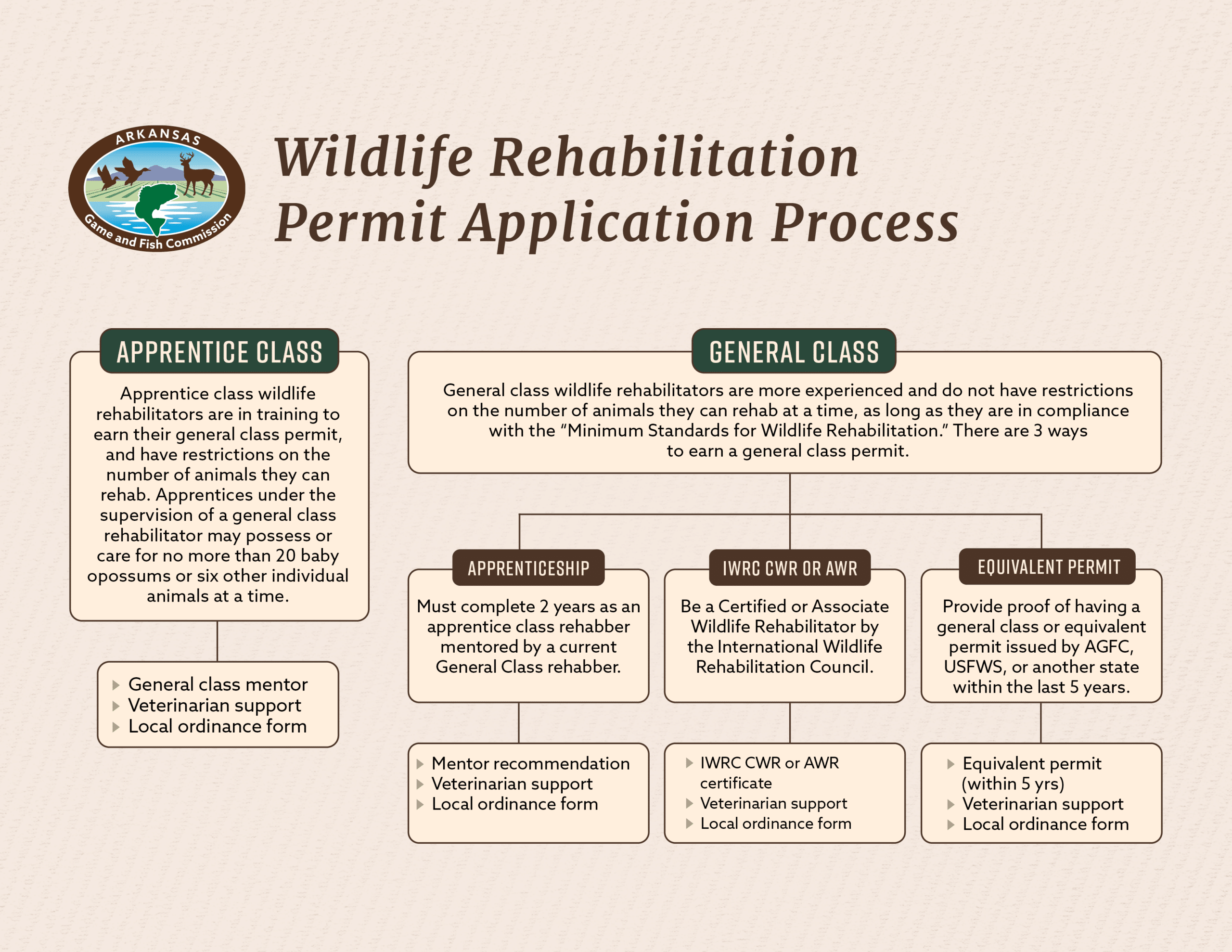
If wildlife rehabilitation is right for you, here are the steps to get an AGFC Wildlife Rehabilitation permit for wildlife other than birds:
- Thoroughly read all AGFC wildlife rehabilitation regulations. Obtain a copy of the Minimum Standards for Wildlife Rehabilitation produced by the National Wildlife Rehabilitators Association and International Wildlife Rehabilitation Council. This document is incorporated into Commission regulations. You must obtain cages/pens that meet these standards.
- Find a general class wildlife rehabilitator that will agree to assist in your training. It would be best if this person is located near you. They do not have to physically oversee your activities but are there to provide advice.
- Complete an AGFC Wildlife Rehabilitation Permit Application in our licensing system. You will need a customer account. Once you have an account, you will add the Wildlife Rehabilitation Permit Application to your cart, complete the application, and checkout. This language can be confusing because the application and permit are free. Click here to apply. Your application will need to be approved by staff. Once approved, you should receive your permit in an automated email. Your permit will also be linked to your account. If your application is approved but you do not receive your permit automatically, please contact us at agfc.health@agfc.ar.gov. New, prospective rehabilitators will need the following documents in JPG or PDF format before starting your application:
- After receiving your Apprentice Class Wildlife Rehabilitation Permit, you can start caring for up to 6 animals at a time (exception: up to 20 baby opossums at a time). You must apply to have your permit renewed annually between June 30 and July 1. Renewal applications require rehabilitators to upload an up-to-date Veterinarian Support Form and a copy of their intake records in PDF or Excel format. You can use one of the three templates of the Wildlife Rehabilitation Intake Sheet for Annual Reporting provided below in the documents section
- Complete 2 years as an active apprentice rehabilitator.
- Submit an AGFC Application for General Class Wildlife Rehabilitation Permit online. General Class has no restrictions on the number of animals you can care for. You will need the following documents in JPG or PDF format:
Please note: If you fall into the following categories, you do not need to complete an apprenticeship to apply for a general class permit: 1) you had an AGFC General Class Wildlife Rehabilitation Permit (or equivalent permit issued by another state) within the last 5 years or 2) you are an International Wildlife Rehabilitation Council Certified Wildlife Rehabilitator.
Wildlife rehabilitators in the State of Arkansas are not employees or volunteers of the Arkansas Game and Fish Commission. They hold permits issued by AGFC but operate independently in accordance with guidelines set forward by the agency. Wildlife Rehabilitators invest their personal time and resources into these activities and are very appreciative of public support. If you would like to help a wildlife rehabilitator in your area, there are several things you can do:
- Volunteer at a wildlife rehabilitation facility. Volunteers are often needed to help transport or care for animals.
- Donate to a wildlife rehabilitation facility to help with operating expenses, supplies, and/or medical care.
- Host a supply drive to collect the items that rehabilitators use most often. This is a great way for families, school or church groups, scouting troops, and others to show their support.
- Milk Replacement Formulas (Ex. Kitten Milk Replacer, Puppy Esbilac, Zoologic®Milk Matrix 33/40, etc.)
- Syringes and latex nipples for feeding (Ex. Miracle Nipple® in multiple sizes)
- Baby foods and cereals
- Dry dog or cat food
- Fresh fruits, vegetables and nuts (a variety, raw and unseasoned)
- Nutritional supplements and probiotics (ex. Nutri-Cal®, Bene-Bac®)
- Grass hays (ex. timothy hay, alfalfa, etc.)
- Puppy housetraining pads or newspaper
- Soft blankets, towels or pillowcases
- Unscented baby wipes
- Cotton swabs (ex. Q-tips)
- Pet hammocks
- Adjustable heating pads
- Disposable gloves
- Paper towels
- Trash bags
- Disinfection and deodorizing products
- Pet carriers and kennels
- Pet food/water bowls (heavy bowls preferred to prevent spilling)
Resources
Documents:
- AGFC Wildlife Rehabilitation Application Guide
- AGFC Mentor Recommendation Form for General Class Application
- AGFC Mentor Support Form For Apprentice Class Application
- AGFC Veterinarian Support Form
- AGFC Local Ordinance Form
- Wildlife Rehabilitator Intake Sheet for Annual Reporting Google Sheets Format
- Wildlife Rehabilitator Intake Sheet for Annual Reporting Microsoft Excel Template
- Wildlife Rehabilitator Intake Sheet for Annual Reporting PDF Format
- 2020 Arkansas Wildlife Rehabilitator Survey Report
- Local Ordinance Compliance Form
- Wildlife Rehabilitation Record Sheet Version 1
- Wildlife Rehabilitation Record Sheet Version 2
- Wildlife Rehabilitation Recordkeeping Instructions
Websites: